Plastic Food Tray Material: Choosing Between PET, PP, and PS
The fastest way to improve a food packaging project is to choose the material before the mold. For almost every commercial food tray, that decision comes down to three thermoplastics — PET, PP, and PS. Each changes how the tray behaves in the cold chain, in the microwave, on the shelf, and in the cost model. This guide compares them on real operating criteria and shows where each material earns its place.
Why the Material Decision Comes First
Most food trays are produced by vacuum forming or blister forming from extruded plastic sheet. The sheet’s polymer defines the finished tray’s entire performance envelope: temperature resistance, clarity, rigidity, grease behaviour, and the way the rim seals with a lid. If the material changes after tooling is built, the project may need a new mold, a new wall-thickness calculation, and another full round of validation. That is why you should choose the material first, then design the tray.
The polymer is the tray. Wall thickness, ribs, lid fit, and printing are refinements of that first decision.
In practical terms, four operating questions replace a long specification document:
- Temperature: Will the tray be refrigerated or frozen at any point in the journey?
- Reheating: Will consumers microwave food inside the tray?
- Presentation: Must the product be visible through the packaging?
- Shelf life: How long will the pack sit before it is eaten?
PET, PP, and PS answer these questions better than the dozens of other polymers in the market. In fact, the three materials cover the overwhelming majority of plastic food trays used by bakeries, sushi and salad producers, caterers, frozen-food processors, and meal-delivery brands, precisely because each one solves a specific set of operating problems.
PET, PP, and PS at a Glance
The table below compares the three materials on the criteria that matter most: clarity, heat tolerance, cold-chain behaviour, moisture resistance, typical applications, and cost position. Read it together with your product’s actual conditions — not with your ideal conditions.
Material-by-material comparison across the criteria that matter most in food tray selection; confirm ratings with your supplier’s test data before tooling.
| Property |
PET |
PP |
PS |
| Clarity |
High transparency, low haze |
Translucent to hazy; easily pigmented |
Good clarity in crystal grade; glossy finish |
| Heat tolerance |
Up to about 60–70 °C; not microwave-safe |
Up to about 120–130 °C; microwave-safe |
Up to about 70–80 °C; no microwave or hot fill |
| Cold and impact |
Holds strength at chilled temperatures; good drop resistance |
Ductile at freezer temperatures; resists cracking |
Brittle below about 5 °C; thin walls can crack |
| Moisture and grease |
Good moisture barrier; thin sections can be heat-sensitive |
Excellent grease and moisture resistance |
Good moisture barrier; moderate grease resistance |
| Typical applications |
Sushi platters, cake and pastry trays, fruit packs |
Lunch boxes, takeaway containers, frozen-food trays |
Catering trays, candy and chocolate trays, short-cycle service |
| Cost position |
Mid |
Mid to higher |
Lowest |
No row of the table should be read in isolation. A tray that looks adequate on paper can fail in real use: dressing migrates into the sheet, a lid fogs over in the chiller, or a hot filling distorts the base. The following sections describe each material’s sweet spot and its limitations.
PET: Clarity for Foods That Sell by Sight
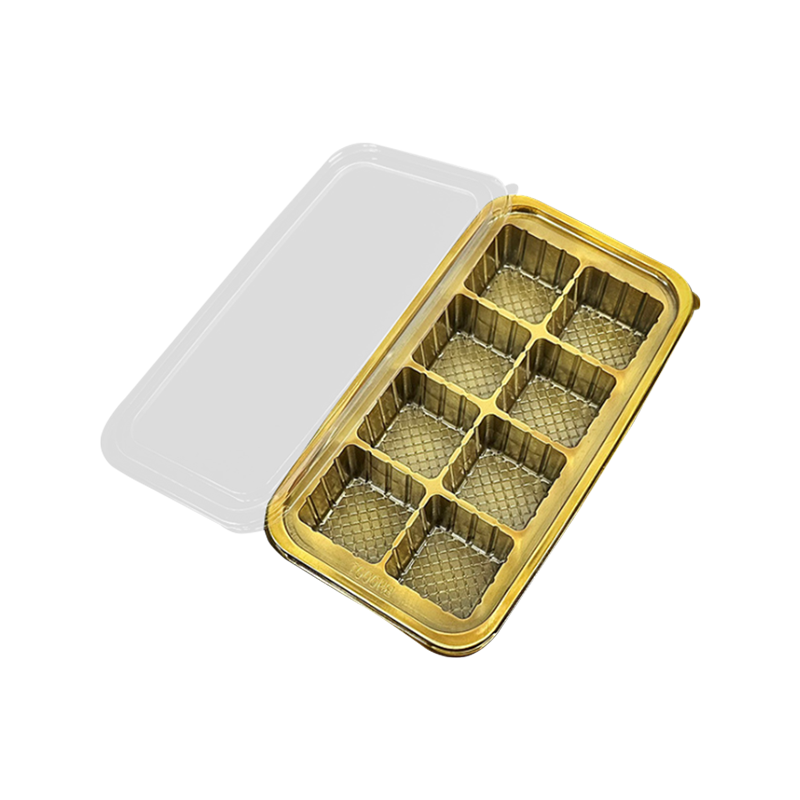
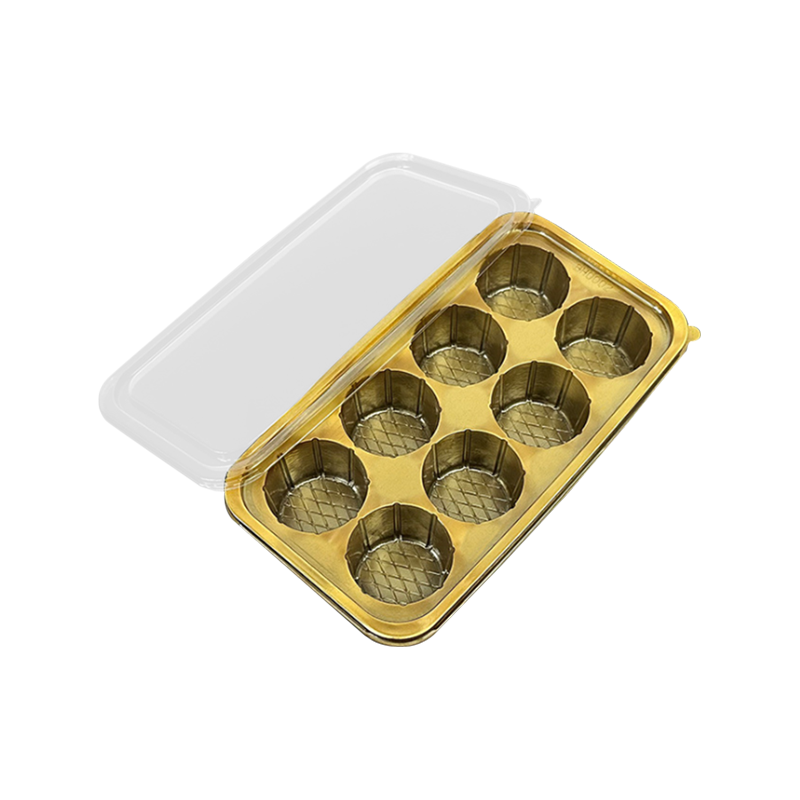
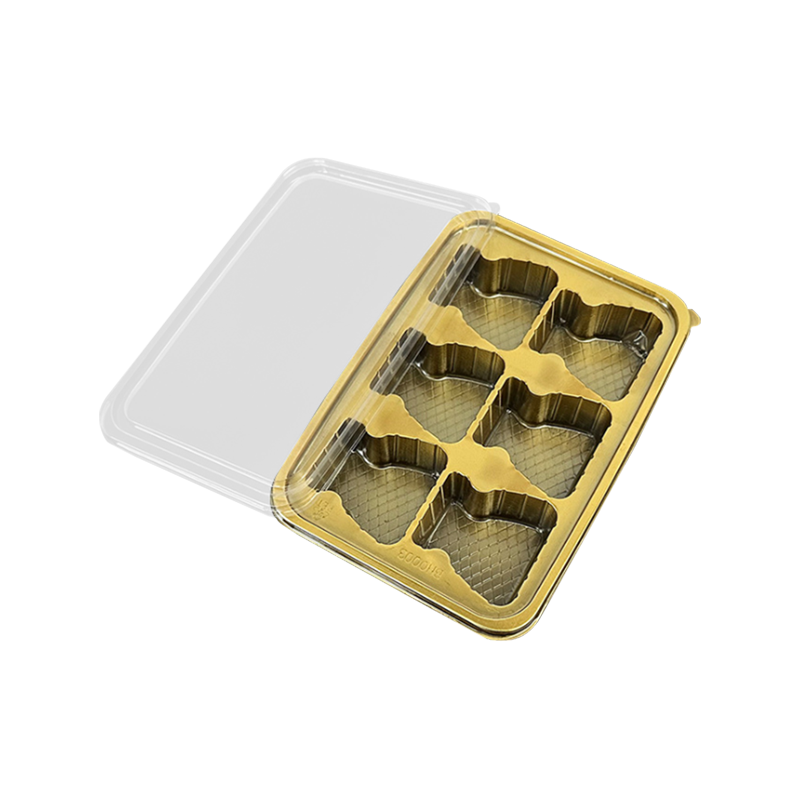
PET, or polyethylene terephthalate, is the material buyers choose when packaging is part of the merchandising. Vacuum-formed PET cake trays, sushi platters, and fruit containers let customers judge colour, texture, and portioning without opening the pack. Because PET thermoforms into deep, multi-cavity shapes, the same sheet can become a simple round dome or an eight-cavity pastry box.
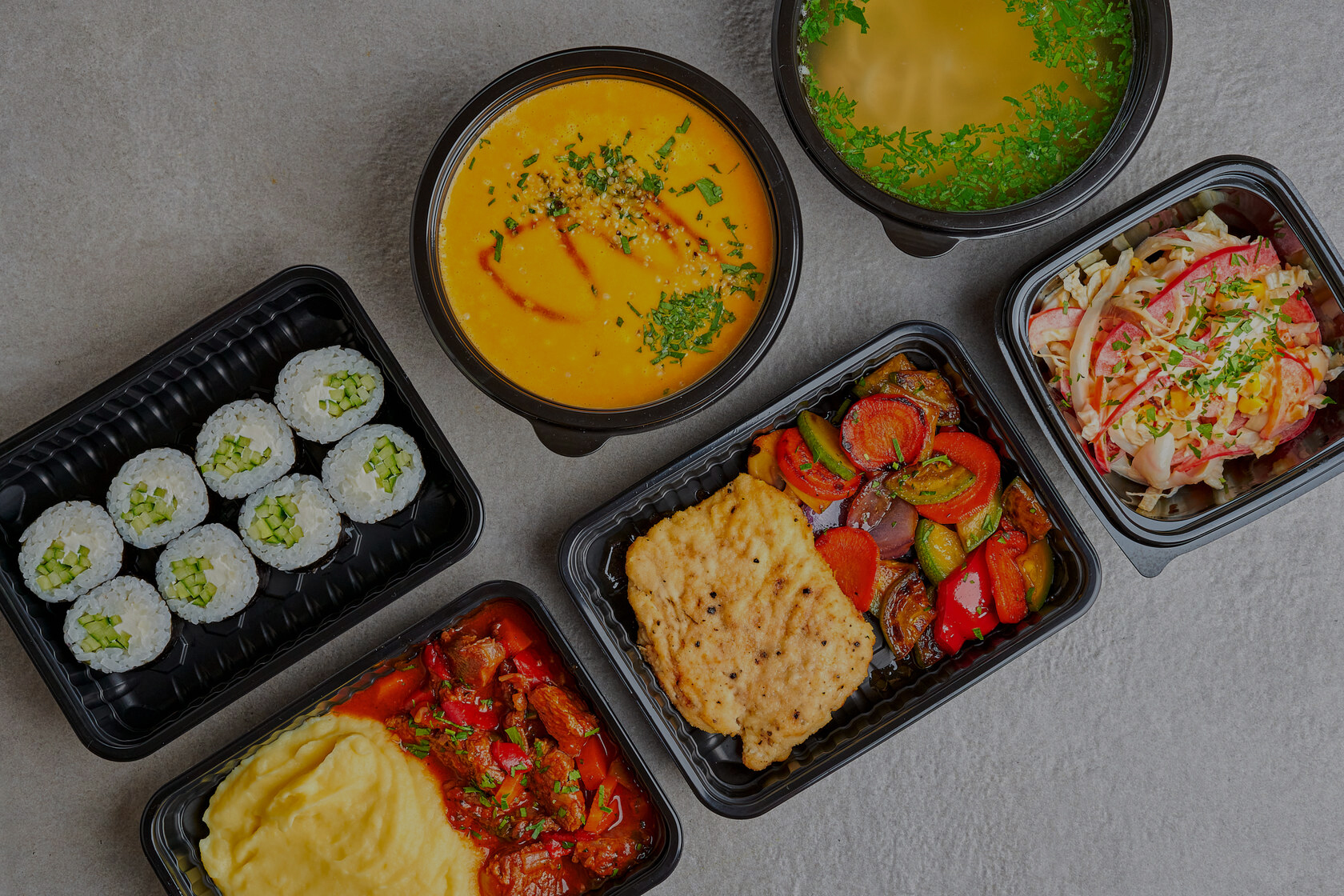
PET performs best in the cold chain. Sushi, cut fruit, salads, cream cakes, and prepared chilled meals benefit from its transparency and its ability to hold clean edges at refrigerated temperatures. A coating on the lid can add anti-fog performance, so condensation does not hide the product during display. Its main limitation is heat: PET trays are not intended for microwave reheating, and thin-walled PET can distort when exposed to hot or greasy contents. Within its temperature envelope, however, it remains the clearest way to present food.
Compliance check. Food-contact approval is not one global standard. The additives, coatings, and inks that make a tray functional are part of the approval package, so confirm documentation for every market you sell into — not just the base sheet.
PP: Heat, Freezing, and Everyday Handling
PP, or polypropylene, is the material to choose when the tray has to survive more than a display case. It tolerates moderate heat, stays ductile at freezer temperatures, and resists grease and moisture better than PET or PS. That combination explains why PP dominates lunch boxes, takeaway containers, frozen-food trays, and multi-compartment trays for hot meals. Consumers can move a PP tray straight from the freezer to the microwave without transferring the food — an increasingly important convenience signal in home delivery and meal prep.
PP also accepts colour and decoration well, which is why gold and silver PP trays appear in premium bakery and catering lines while clear PP lids flex enough to click shut without cracking. For a closer look at the material’s behaviour, our detailed review of PP plastic food tray material characteristics covers performance, advantages, and application scenarios in depth.
A reliable default for heat. If your product must pass through both frozen storage and microwave reheating, PP is the safest single-material answer. Specify it early, and the rest of the packaging system — lid design, sealing, print — can be built around that reliability.
PS: Economy and a Smooth Finish for Short Service Cycles
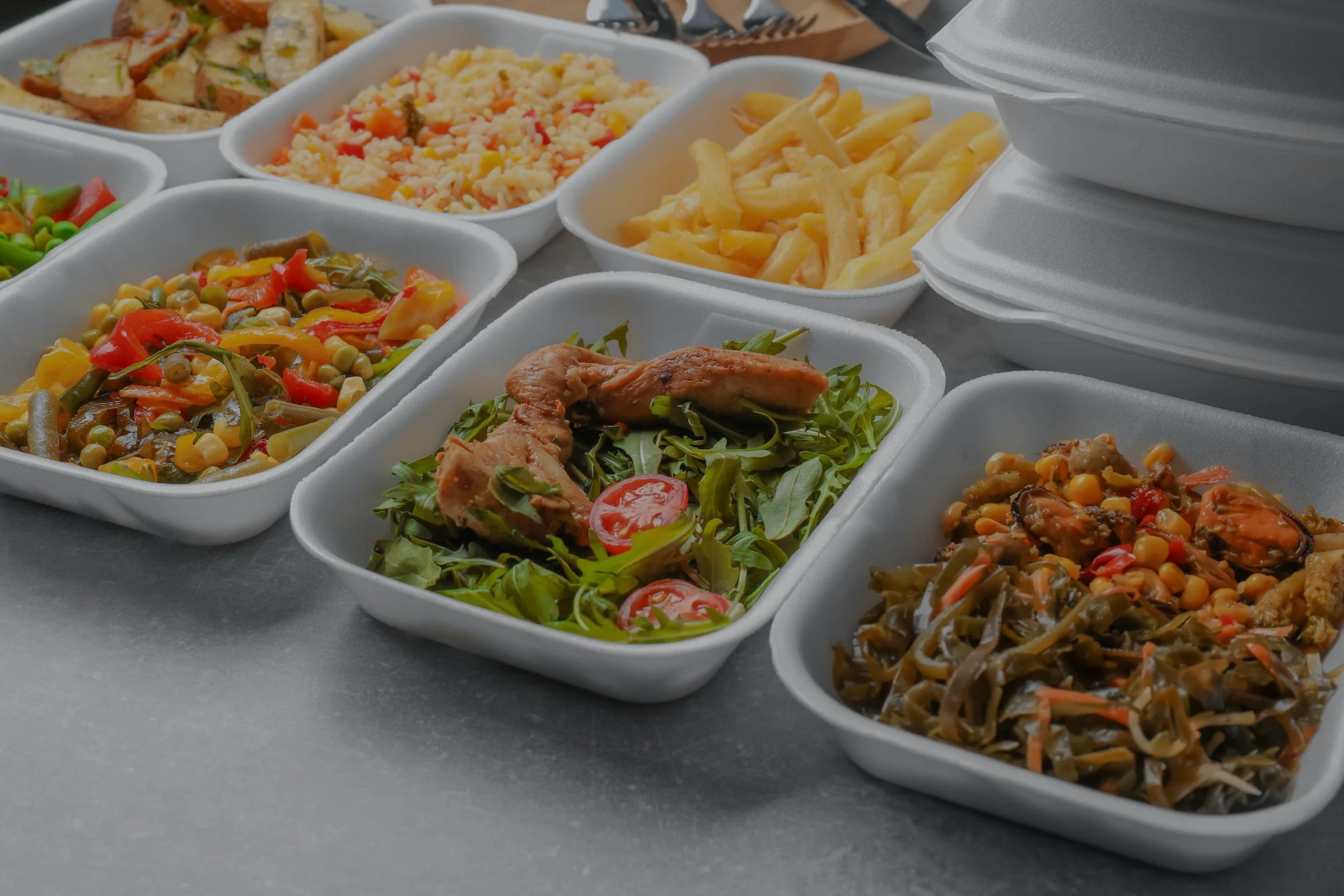
PS, or polystyrene, is the workhorse when the tray does not need extreme temperatures. It is the least expensive of the three, thermoforms quickly, and takes a smooth, glossy surface that suits candy trays, dessert displays, and event catering. The familiar silver food tray used by caterers and buffets is almost always PS with a metallic finish.
PS has real limits. It turns brittle in cold storage, so it is risky for frozen distribution. Its heat tolerance is low, meaning hot fill and microwave reheating are out of the question. Thin wall sections can also crack under repeated handling. But for short-cycle service at ambient temperature, PS delivers the lowest per-unit cost of the three materials.
Never microwave PS. Do not put a PS tray in a microwave or fill it with food above roughly 70–80 °C. The material can soften and deform, and thin-wall designs may develop stress points that break the seal or leak.
What to Verify Before You Commit
Once the material shortlist is fixed, the professional step is validation. The checklist below prevents most ordering mistakes in food tray supply:
- Run a real-product test. Fill the tray with your actual food — sauces, oil, moisture, weight — and hold it at the real storage temperature for the full intended shelf life.
- Check dimensional consistency. Trays from one order should nest, seal with their lids, and flow through your packing line without jams.
- Test the lid-and-tray pair. Sealing behaviour, anti-fog performance, and stacking strength belong to the pair, not to the tray alone.
- Verify compliance documents. Confirm food-contact approvals, coatings, and inks for every market you sell into.
- Clarify MOQ and lead time. A custom mold and a standard catalogue item run on entirely different calendars.
Suppliers who can produce precise thermal data, wall-thickness tolerances, and lid-sealing results are safer partners than those who only send catalogue photographs. The sample run is the moment to judge the difference.
Test with your real product. A tray that looks flawless on a desk behaves differently at 4 °C with a wet filling inside. Validate with your actual food, your sealing machine, and your worst-case transport box before placing a large order.
Environmental Pressure on Tray Material Choice
Sustainability now shapes tray material selection as much as price and performance. The practical levers are lightweighting — using a thinner wall without losing strength — and choosing polymers with clearer end-of-life routes. PET has an established recycling stream in many regions, PP is increasingly accepted in mixed rigid-plastic collection, and PS remains the most difficult of the three to recycle economically.
The supplier’s process matters here as well. Vacuum forming and blister forming depend on consistent sheet thickness, so a plant that controls its process tightly can often run a lighter tray without sacrificing rigidity or seal quality. New recycling technologies are also evolving, which means the material landscape will keep changing over the coming years.
A practical strategy is to choose today’s reliable option and keep the packaging architecture flexible enough to migrate to lower-impact materials as certified alternatives appear. Buyers who discuss downgauging, post-consumer recycled content, and end-of-life routes with their supplier make better decisions than those who compare catalogue prices alone.
Choosing a plastic food tray material is, in the end, a risk-management exercise. PET gives you the clearest presentation for foods that sell by sight; PP gives you the widest temperature range and the only genuine microwave compatibility; PS gives you the lowest cost when shelf life is short. The order of operations is simple: define the product’s thermal and mechanical conditions, shortlist the material that genuinely meets them, and validate with a real sample run before scaling. That sequence separates a smooth launch from a packaging problem that follows you through the supply chain.
If you are evaluating trays for a bakery, sushi line, meal-prep service, or frozen-food range, compare materials against your actual operating conditions before commissioning any tool. To review the range we manufacture, browse our factory-direct PET, PP, and PS food tray range and request samples ahead of your next order.



 English
 عربى
عربى Español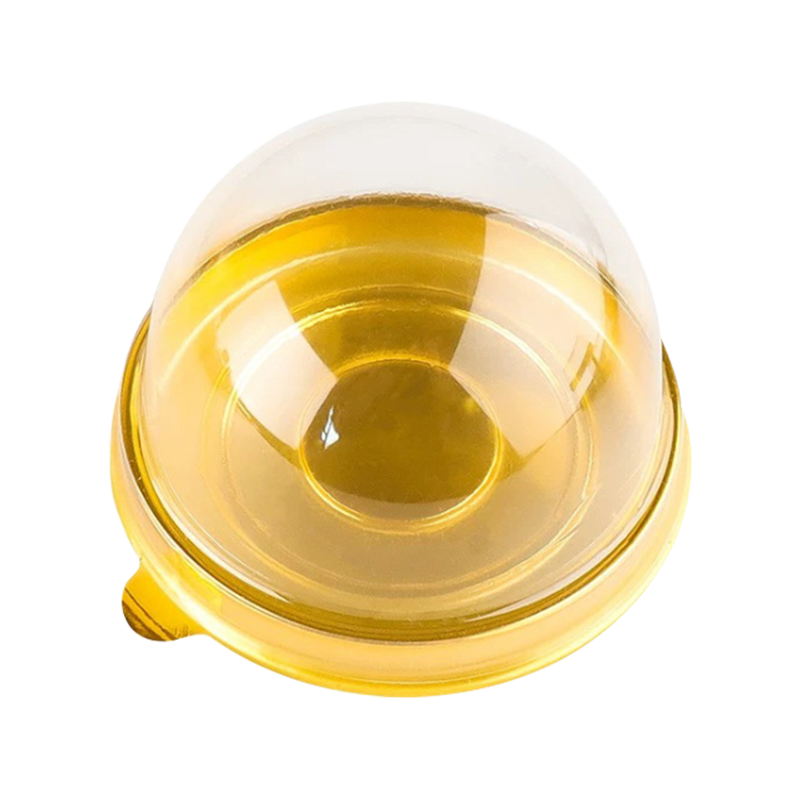



 Custom PVC Blister Plastic Boxes Manufacturers
