


 English
 عربى
عربى Español
Plastic Food Safe Tray Heat Resistant: How PET, PP and PS Behave Under Heat
Packaging Materials Guide
PP, PET and PS behave very differently as temperatures climb. A sourcing-focused guide to where each material belongs on a food production line — and where it fails.
A ready-meal brand once swapped its reheatable lunch line from PP to PET trays for a single reason: clarity. Shelf photos improved, sales held for two weeks, and then the complaints arrived — lids popping open in staff microwaves and tray corners doming upward over hot curry. Nothing about the material was unsafe. It was simply the wrong plastic for the temperature.
Here is the short version up front: when a food-safe tray will meet heat — microwave reheating, hot filling or a hot sealing head — polypropylene (PP, resin code 5) is the default choice. PET (code 1) delivers outstanding clarity and cold-chain strength but softens well below boiling water. Polystyrene (code 6) is rigid, glossy and economical, and the least forgiving once temperatures climb. “Food safe” and “heat resistant” are two separate qualifications, and confusing them is one of the most expensive mistakes in tray sourcing.
The Short Answer: Match the Plastic to the Temperature
Polypropylene melts at roughly 160-165°C, and food-contact PP trays are typically rated for continuous service at about 100°C with brief excursions toward 120°C. Microwave-reheat PP is the industry workhorse for ready meals, soups and saucy lunch boxes. Impact copolymer grades also stay serviceable in freezer storage down to around -20°C, which is why freezer-to-microwave programs are built on PP almost by default.
Amorphous PET (APET) — the transparent star of bakery, sushi and salad displays — has a glass transition near 70-80°C. In practice, thermoformed PET trays begin losing stiffness between roughly 60 and 70°C, so hot-fill and microwave cycles are off the table. The exception is crystallized PET (CPET), a dual-ovenable specialty rated toward 200°C; it is a different product at a different price, not a hidden property of ordinary clear PET.
General-purpose polystyrene offers gloss, rigidity and low cost, but softens within the 70-90°C range, grows more brittle in freezer conditions, and is generally excluded from microwave programs.
Heat resistance is never a single number. It is a time-and-temperature envelope — 100°C for ten seconds and 100°C for ten minutes are two different engineering problems.
| Material | Resin code | Typical short-term heat tolerance | Freezer behavior | Microwave reheating | Natural fit |
|---|---|---|---|---|---|
| PP | 5 | About 100°C continuous; brief peaks near 120°C | Good to roughly -20°C (impact grades) | Yes, with tested grades | Ready meals, saucy lunch boxes, hot deli packs |
| PET | 1 | Softens between roughly 60-70°C | Strong and tough when chilled | No for APET; CPET is the oven-safe exception | Sushi, salads, cakes, ambient bakery display |
| PS | 6 | Softens within roughly 70-90°C | More brittle when frozen | Not recommended | Cold deli trays, divider trays, ambient confectionery |
What “Food Safe” Certifies — and What It Does Not
Food-contact compliance is a question of composition and migration, not mechanical performance. In the United States, food-contact polypropylene falls under 21 CFR 177.1520, PET under 177.1630 and polystyrene under 177.1640; in the European Union, Regulation (EU) No 10/2011 sets an overall migration limit of 10 mg/dm² under defined time-and-temperature conditions. A certificate covering those points tells you the material is lawful for food contact. It does not tell you whether the tray will survive your filling temperature, your sealing head or your customer's microwave program.
That second question is answered by use-condition testing: dimensional stability after a real reheat cycle, seal integrity at line speed, and deformation behavior across a chilled-to-hot transition. Reputable tray manufacturers run these tests against the customer's actual process instead of quoting a resin datasheet and hoping.
Matching the Tray to Its Thermal Journey
Freezer to microwave: the PP corridor
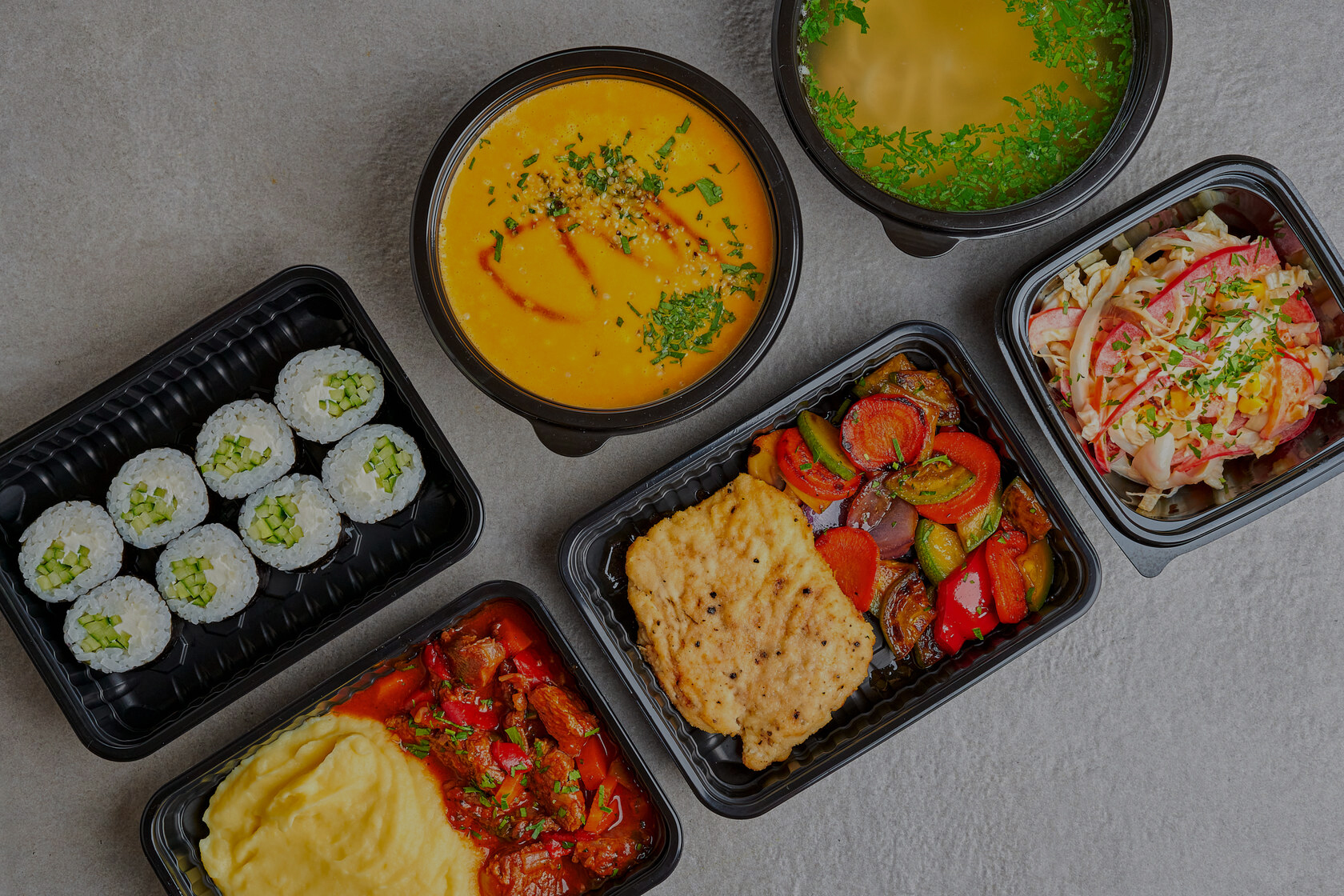
Frozen ready meals, microwaveable lunch boxes and roasted chicken packs live on PP because a single material covers the entire journey: -20°C storage, cold-chain transport, a 100-120°C reheat, and direct contact with oils and sauces. Design details matter as much as resin choice — venting, anti-overflow lid geometry and wall gauge decide whether sauce stays contained while the tray flexes at temperature.
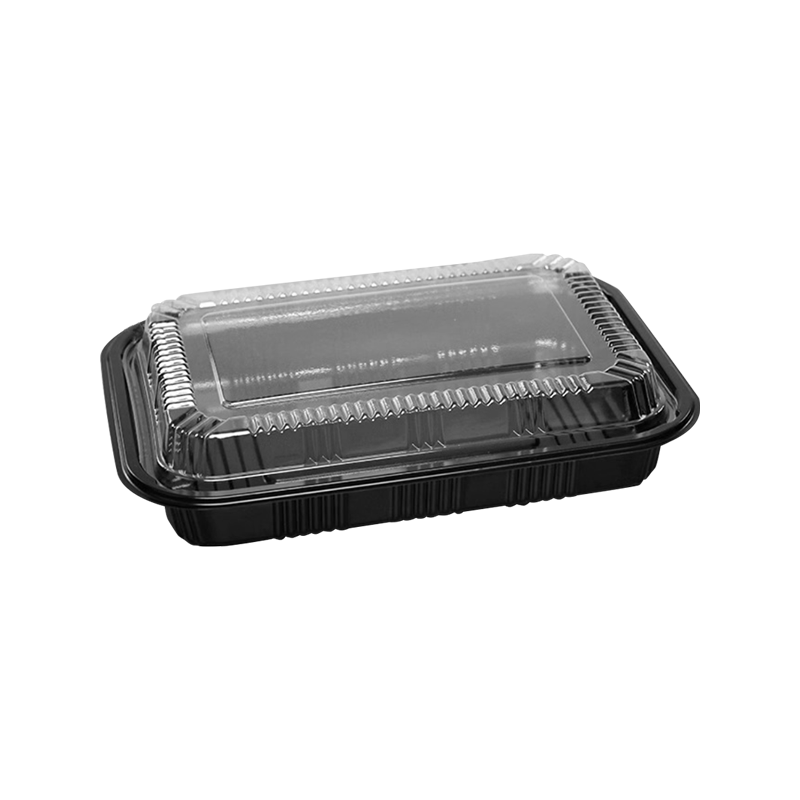 Microwave-Safe Anti-Overflow Covered Food Packaging BoxA PP microwaveable box with a matched anti-overflow lid that controls steam and sauce splatter during 100-120°C reheating, fitting the article's point that lid geometry and venting decide whether PP ready-meal trays reheat cleanly.View Product →
A validated system pairs the base with a matched lid rather than treating them as separate purchases. Where the journey starts in the freezer, the same logic holds: a disposable frozen food packaging tray in PP cycles from cold storage into reheat without turning brittle in between.
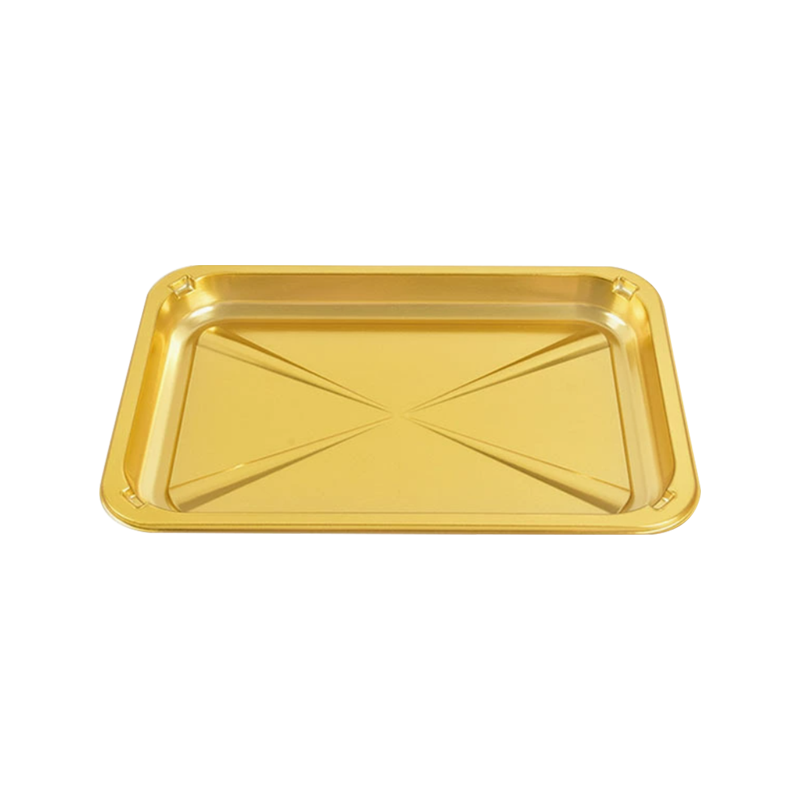 Disposable PP Frozen Food Packaging TrayA disposable PP tray designed to move from -20°C freezer storage into reheat without turning brittle, illustrating the article's case that base and lid work as one validated cold-to-hot packaging system.View Product →
For a deeper technical comparison, this analysis of PP food tray material characteristics and application scenarios walks through copolymer selection and scenario matching in detail.
Cold display and bakery: where PET earns its clarity
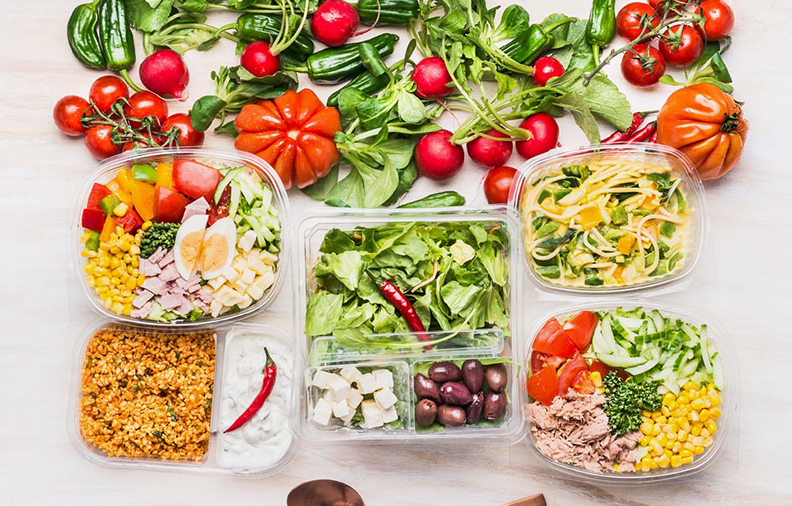
Sushi, sashimi, fruit, salads and layered cakes sell through sight, which is why PET dominates chilled display: high transparency, reliable strength at refrigeration temperatures, and compatibility with anti-fog lids that stop condensation from hiding the product. The constraint is heat discipline. Keep PET trays away from hot cases, hot-fill lines and reheat stations, and they will outperform nearly anything on presentation.
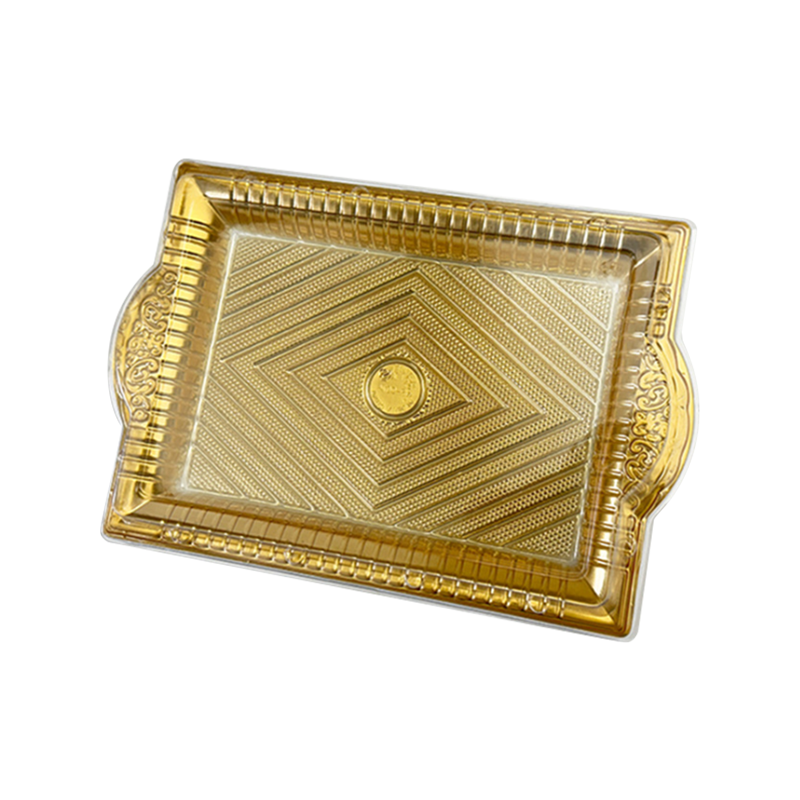 Disposable Transparent Thick Pastry TrayA thick, high-transparency tray suited to chilled display of cakes, sushi and desserts where presentation matters, contrasting with the article's caution that clear trays like PET must stay away from heat and reheat stations.View Product →
PS: economical rigidity, zero heat ambition
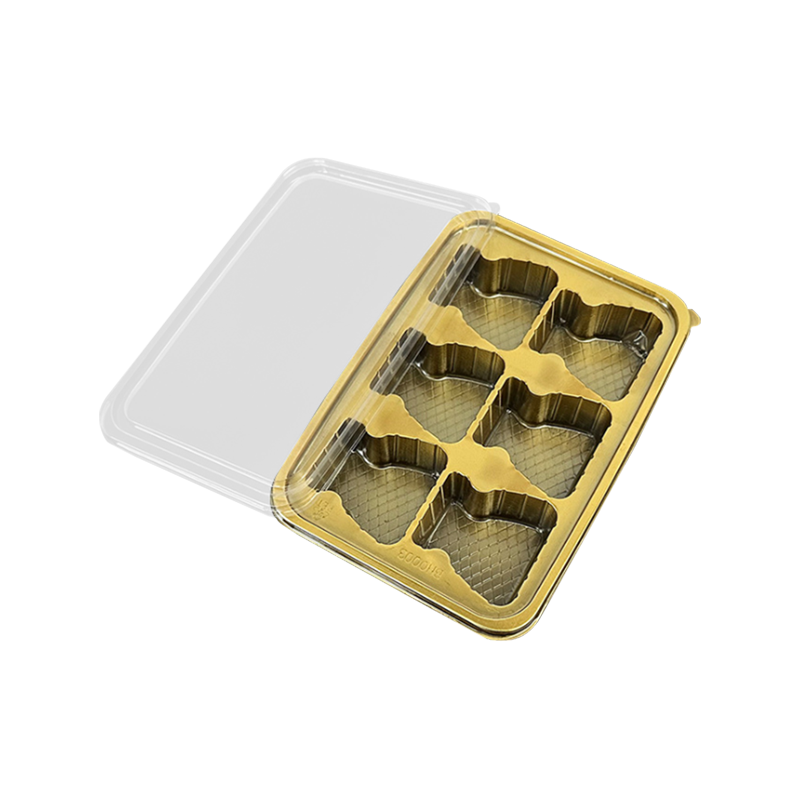
Polystyrene still earns its place for cold deli trays, multi-compartment divider trays and ambient confectionery packaging, where stiffness and low cost matter and heat never enters the picture. The failure mode to police is simple: PS plus a microwave, a heat lamp or boiling gravy equals deformation — and sometimes a returned shipment.
Procurement Checks That Prevent Warped Trays
Most tray failures in the field are not chemistry failures; they are specification failures. These checks cost little up front and prevent the expensive ones:
- Map the full thermal journey before choosing a resin: filling temperature, storage temperature, transport conditions, reheat method and duration.
- Ask for use-condition data — dimensional stability, lid seal integrity and migration results at your real cycle, not just resin datasheet values.
- Specify wall gauge deliberately; a fraction of a millimetre changes how a tray handles heat sealing and reheat deformation.
- Match lid and base materials so thermal expansion and sealing behavior stay consistent; mixed PP-base and PET-lid systems need separate validation.
- Run a pilot with your actual product across a realistic shelf period before committing to volume tooling.
- Tie food-contact documentation to the mold: any resin or tooling change should trigger re-validation.
The Bottom Line for Buyers
Treat food-contact compliance as the entry ticket and heat resistance as a separate engineering decision. Specify PP when the tray's life includes heat. Specify PET when presentation at chilled or ambient temperature is what sells the product. Keep PS for cold, rigid, cost-conscious applications. As a manufacturer operating PET, PP and PS tray lines with in-house mold design, we build the thermal specification into the tooling conversation from day one — the plastic food tray range shows how the three materials divide the work.
The cheapest line on a quote sheet is rarely the cheapest in the field. One warped batch under heat lamps costs more than the specification meeting that would have prevented it.



- The company requires rigorous, using a high starting point, trustworthy, quality, and actively develop and innovate, the pursuit of excellence route!
CONTACT US
- Tel: +86-15026677788
- E-mail: [email protected]
- Add: No.11 Huafeng Road, Anhua Community, Anhua Town, Zhuji City, Shaoxing, Zhejiang, China
GET A QUOTE
Copyright @ Donghang Polymer Material Technology Co., Ltd. All Rights Reserved.
 Custom PVC Blister Plastic Boxes Manufacturers
