


 English
 عربى
 Español
Carton Sleeve and Food Tray Packaging: How Paperboard Sleeves Pair with Plastic Trays
Packaging Insight
Carton Sleeve and Food Tray: The Pairing That Sells the Food and Protects It
Good food packaging rarely wins on a single material. The carton sleeve speaks on the shelf; the plastic tray holds the food through transport and display. Put them together and you get a system that handles brand expression, structural protection, and the eating experience at once.
Pick up a sushi box from the chilled aisle, a slice of cake from a bakery, or a bag of frozen dumplings from the supermarket, and you have probably held this combination: a clear or compartmented plastic tray holding the food, wrapped in a printed paperboard sleeve. It looks simple. Behind it are two materials, two production steps, and two design logics that have to agree.
This article is about why that pairing works, how to choose it, and the details that are easy to miss when you take it from concept to production.
Why carton sleeves and food trays keep showing up together
The division of labor is clean. The tray does the holding: sealing, compartmenting, temperature resistance, anti-fog, stacking. The sleeve does the talking: print area, brand recognition, regulatory information, window display. Each does its job, and each covers for the other.
For chilled and frozen products, the sleeve also buffers condensation and keeps labels from lifting. For hot food, it gives the consumer a surface to hold without touching the tray directly.
From a supply chain angle, the combination is practical. Trays and sleeves can be produced and shipped separately, then married at the packing line. Trays nest and stack; sleeves ship flat. Storage and freight costs stay lower than with a one-piece molded package.
What the carton sleeve actually does in food packaging
The first brand surface
On the shelf, the consumer sees the sleeve before the food. Color, type, graphics, and material feel set the first impression. A matte tactile film with a foil stamp reads differently from a plain white card — and so does the price expectation.
A second layer of structure
The sleeve is not just decoration. Wrapped around the tray, it adds rigidity and reduces deformation during stacking and transport. For thinner PET or PP trays, the sleeve works like an exoskeleton.
A legal carrier
Ingredients, allergens, shelf life, storage conditions, recycling marks — these need flat space. Trays are small and curved, and printing on them is inconsistent. The sleeve offers a clean, large print surface, which makes it the natural home for mandatory information.
Part of the sustainability story
Paperboard sleeves often use FSC-certified board and water-based inks, and they have a well-established recycling path. Putting paper on the outside and plastic on the inside also gives brands a visual way to answer consumer pressure on plastic reduction.
The sleeve is not packaging around the food. It is the part of the packaging the consumer actually reads, holds, and remembers.
Four sleeve types, four tray relationships
Not every sleeve looks the same. Depending on tray shape, display needs, and transport conditions, four types cover most food applications.
| Sleeve type | Structure | Tray fit | Typical use | Window |
|---|---|---|---|---|
| Full wrap | Closed on four sides, open top and bottom | Standard rectangular trays | Frozen food, bento, ready meals | Optional |
| Belly band | A band around the tray's middle | Round, square, or shaped trays | Bakery, candy, chocolate | Not applicable |
| Tray sleeve | Wraps the tray with a die-cut opening | Clear or compartmented trays | Sushi, fruit, salad | Common |
| Multipack | Holds several small trays together | Mini tray sets | Party platters, samplers, gift sets | Optional |
Choose the type by starting with the tray's length, width, height, and stacking pattern, then decide how much of the food you want the consumer to see. A full wrap gives the most protection and the least visibility. A tray sleeve gives the most visibility, but it depends on the tray itself being clear or well-designed.
Get the tray right, and the whole pack holds together
The sleeve sets the first impression. The tray sets the actual experience. Choose the wrong tray and no sleeve will save it.
PET: clarity and stiffness
PET trays are clear, rigid, and stable in cold display. For cake, sushi, fruit, and salad — products that are bought with the eyes first — PET is usually the first choice. Its service range sits roughly between -40°C and 70°C, so it handles chilling and freezing well but is not made for microwave reheating.
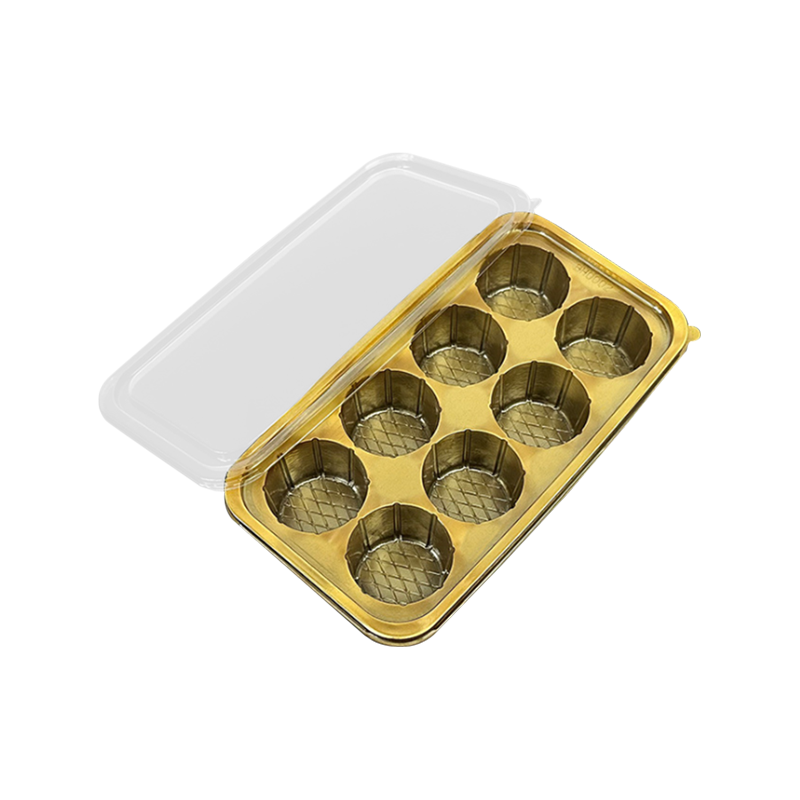
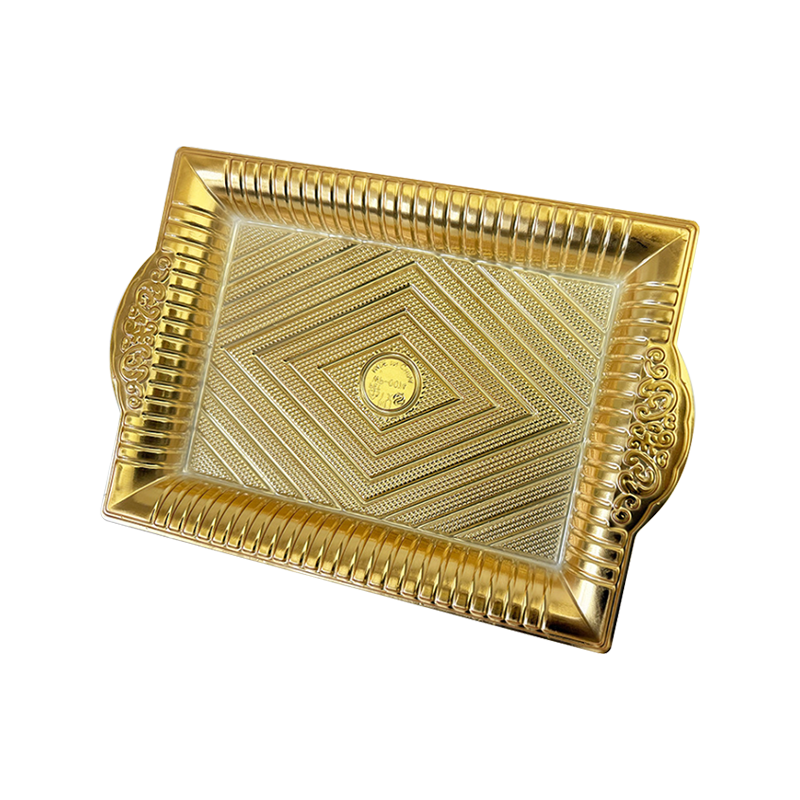 Gold PET Cake Vacuum Tray for Bakery DisplayGold PET cake tray with a sealed structure for cakes and baked goods; suited to cold-display packaging needing stable shape and transport protection.View Product →
PP: heat resistance and toughness
PP trays take higher temperatures, work in the microwave, and suit hot takeaway, bento, and frozen food. They are less transparent than PET but tougher and more chemically resistant. For meals that will be reheated, PP is the safer base. If you want a deeper comparison of material behavior, this analysis of PP food tray characteristics is a useful starting point.
PS: cost and compartmenting
PS trays are low-cost and rigid, which makes them a good fit for cold platters, divider trays, and confectionery. They are more brittle than PET and PP, so they are not the right choice for heavy loads or high heat — but in standardized, high-volume cold food packaging they remain competitive.
Board and print decide how the sleeve feels
The tactile quality of a sleeve comes down to three layers: board, surface treatment, and printing method.
- Board: solid bleached sulfate, folding boxboard, or corrugated. Food packaging usually runs 300–400gsm SBS for a balance of stiffness and print quality.
- Surface: matte film, gloss film, tactile film, or water-based varnish. Matte and tactile finishes read as premium; gloss reads as loud.
- Printing: offset for large volumes and fine detail; flexo for mid-to-large volumes and cost sensitivity; digital for short runs and multiple versions.
If the budget allows, matte tactile film with spot UV is the most reliable premium combination in food packaging. It does not reflect light, feels soft in the hand, and pairs well with a die-cut window — matte frame, clear view.
Six scenarios where sleeves and trays work together
Different categories ask different things of the sleeve and the tray. These six are the most common combinations.
Bakery and pastry
Cakes, bread, and cookies need display and protection. A PET or PP tray provides the base; a paperboard sleeve provides the brand surface. Belly bands and tray sleeves are the most common formats.
Sushi and sashimi
Sushi demands clarity and anti-fog performance. A PET tray with an anti-fog lid, wrapped in a windowed sleeve, keeps the fish visible while carrying brand and origin information. The growth of the ready-to-eat market has pushed this format forward quickly — this look at how plastic fruit and sushi boxes are reshaping the ready-to-eat market covers the wider trend.
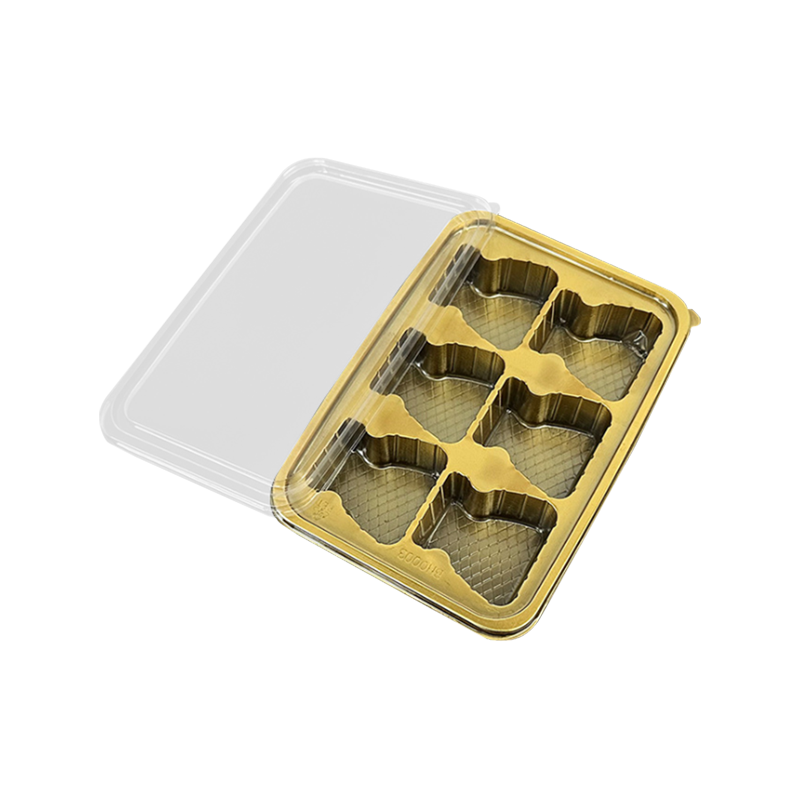
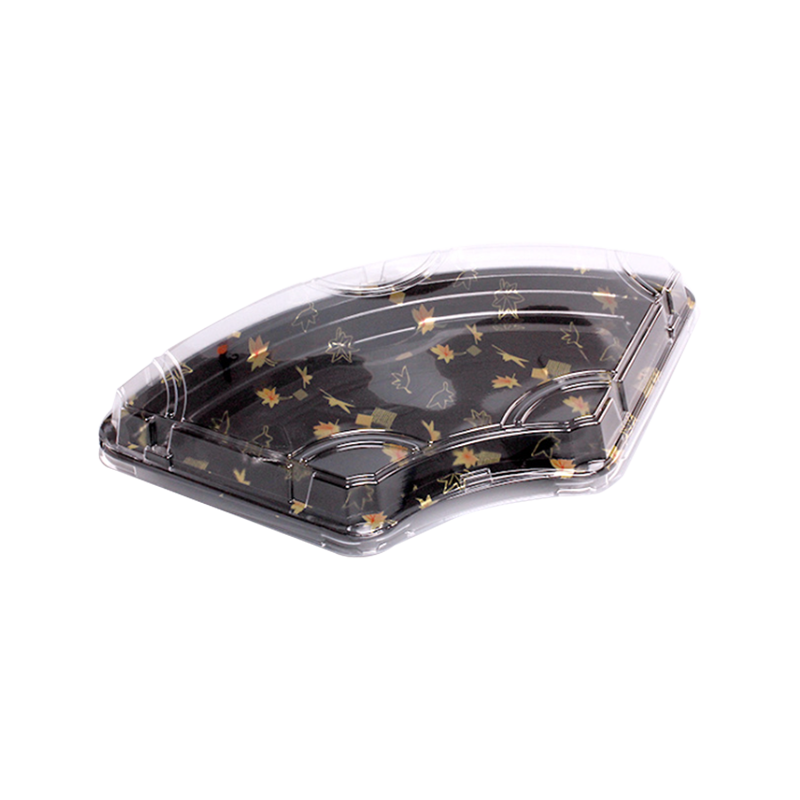 Fan-Shaped Sashimi Packaging Box with Transparent LidA fan-shaped disposable box with a transparent lid for sushi, sashimi, and salads; its visible presentation and sealing suit ready-to-eat displays and transport.View Product →
Fruit and light meals
Fruit and light meals sell on freshness. A fully transparent PET tray with a windowed sleeve is the most direct expression. The window shape can follow the fruit silhouette, which adds a bit of character without extra cost.
Salad and chilled food
Salads need anti-fog lids to keep condensation from blocking the view. Sleeves are usually belly bands or partial wraps, which keep the chilled cabinet looking tidy.
Candy and chocolate
Candy and chocolate lean harder on the sleeve's print performance. A blister tray shows individual pieces; a full wrap or belly band carries the brand, often with foil stamping or embossing to signal gifting.
Frozen food
Frozen food needs a low-temperature tray and a moisture-resistant sleeve. PP trays with full-wrap sleeves are the standard combination. The sleeve has to handle humidity swings in the freezer without curling or delaminating.
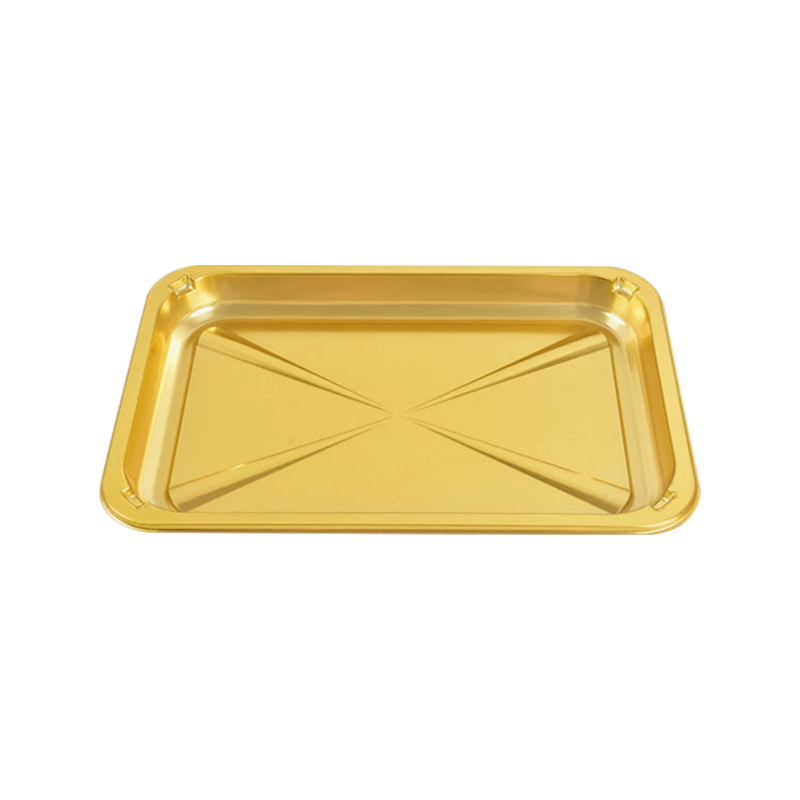 Disposable Frozen Food Packaging Tray for WholesaleA gold frozen-food tray with sealed, stackable design for meat, fish, vegetables, and cooked food; relevant for freezer storage and transport where moisture protection matters.View Product →
Five things to settle before you design the sleeve
- Tray tolerance: the sleeve's inner dimension should run 1–2mm larger than the tray's outer dimension. Too tight and it will not assemble; too loose and it will feel sloppy.
- Window position: align the window with the most attractive part of the food, and avoid the tray's divider lines.
- Stacking: if the product will be stacked, the sleeve needs a reinforced top and bottom edge or an inward fold.
- Print bleed: the sleeve is curved, so artwork has to account for distortion when laid flat. Keep at least 3mm bleed.
- Recycling marks: print paper and plastic recycling marks separately so consumers can sort correctly.
Sustainability is a structural question, not a slogan
A paperboard sleeve plus a plastic tray sounds like two materials stacked together, but the recycling path is actually clearer than many composite packs. The sleeve and tray separate easily at the consumer end and go into paper and plastic streams respectively.
One detail that gets overlooked is the glue on the sleeve. Hot-melt or water-based adhesives separate more cleanly; a strong pressure-sensitive adhesive can contaminate the paper stream.
The other direction is downgauging. Shaving 0.1mm off a tray or 20gsm off a sleeve is invisible on a single unit and meaningful across a million-unit order — as long as the structure still holds.
Downgauging is not just cutting weight. As the tray gets thinner, the sleeve's supporting role grows, and the stack test has to be rerun.
A final note
The relationship between a carton sleeve and a food tray is a bit like clothes and a person. The tray is the body; the sleeve is the expression. When they work together, the product looks alive on the shelf. When they do not, even expensive printing feels off.
If you are planning a new food pack, start with the tray: decide what temperature, what seal, and what viewing angle the food needs. Then design the sleeve: decide at what distance it will be seen, what it has to say, and what kind of hand-feel will keep the consumer holding it. Get the order right and the whole pack follows.






- The company requires rigorous, using a high starting point, trustworthy, quality, and actively develop and innovate, the pursuit of excellence route!
CONTACT US
- Tel: +86-15026677788
- E-mail: [email protected]
- Add: No.11 Huafeng Road, Anhua Community, Anhua Town, Zhuji City, Shaoxing, Zhejiang, China
GET A QUOTE
Copyright @ Donghang Polymer Material Technology Co., Ltd. All Rights Reserved.
 Custom PVC Blister Plastic Boxes Manufacturers
