


 English
 عربى
 Español
Automatic Fast Food Tray Sealers: Choosing Trays That Seal Right First Time
Tray Sealing · Packaging Notes
Automatic Fast Food Tray Sealers: Getting the Tray Right Before the Film
A sealing line is a two-part system — machine and tray. Here is what food teams, buyers, and packaging engineers should check before the first roll of film goes on.
Walk along a busy fast food production line and you hear the machine before you see it: a short hiss of heated film, a firm press, a quick trim. That is an automatic fast food tray sealer at work, closing a filled tray with film, cutting it free, and sending it down the belt before anyone has time to reach for a lid.
We have spent years making the trays that run through machines like these, and the same point comes up in almost every conversation with a packaging engineer: the sealer is only half the system. The tray is the other half, and it quietly decides whether the line runs smoothly at eight in the morning or stops every twenty minutes for an adjustment.
What an Automatic Fast Food Tray Sealer Really Does
A tray sealer is not a lid press and it is not a flow wrapper. It takes a pre-filled tray, draws lidding film from a roll, heats the film and the tray flange, presses them together, and cuts the film to the tray outline. The result is a sealed pack with no separate lid to snap on and no loose film to tuck underneath.
The machine family is broad. Semi-automatic units suit small kitchens and trial runs. In-line automatic machines handle volume with an infeed conveyor, a sealing station, and a discharge belt. Rotary models seal several trays per cycle and appear wherever one menu item dominates production. Many machines also offer modified atmosphere packaging or vacuum, which is how a chilled ready meal reaches a longer shelf life without additives.
Whatever the format, every one of these machines has the same physical relationship with the tray: heat, pressure, and time applied to a narrow band of plastic around the rim.
The Tray Flange Decides More Than You Think
That narrow band is the flange, and it is where most sealing problems begin. A flange that looks perfectly acceptable on a shop shelf can be the reason a line loses speed.
Four things worth measuring before you order tooling
- Usable flange width. Most seal heads need a clean, flat band, and eight to fifteen millimetres is the practical range. Too narrow and the seal is weak; too wide and film consumption climbs.
- Flange flatness. Warping, curl, or a wavy rim means pressure lands unevenly — some areas overheat while others barely touch.
- Thickness consistency. Sealing is a heat transfer problem, and variable wall or flange thickness narrows the working window fast.
- Denesting behaviour. Trays must separate cleanly and predictably, or the magazine jams and an operator spends the shift rescuing the line.
A tray designed for hand filling is not automatically a tray designed for a sealer. Ask for samples and run them before any tooling is cut.
Matching Tray Material to the Seal You Need
PET, PP, PS, and the newer bio-based blends all seal — but they seal differently, and they tolerate different amounts of heat. The table below is a starting point rather than a specification; the film supplier and the machine builder both need a say.
| Material | Heat tolerance in service | Sealing behaviour | Typical fast food use |
|---|---|---|---|
| PET | Cold to warm; not for oven or microwave reheating | Seals readily with PE-based lidding film; clear, glossy finish | Sushi, fruit, bakery, chilled desserts |
| PP | Hot fill and microwave reheating | Needs a PP-compatible film for a true weld seal; strong and flexible | Hot ready meals, rice bowls, frozen dishes |
| PS | Cold and ambient | Rigid and easy to seal, though more brittle under impact | Deli items, chocolate, ambient snacks |
| Bio-based blends | Varies widely by grade | Narrower sealing window; confirm with the film supplier | Cold salads, light chilled items |
For hot fast food, PP is usually the material worth studying first, because its sealing window and its microwave performance are linked. Our notes on PP tray material characteristics and application scenarios go deeper into that relationship.
Frozen and chilled programmes are often where sealing pays back fastest, since a well-made seal limits ice crystal growth and freezer burn. A rigid PP tray with a clearly defined flange gives the seal head something consistent to press against.
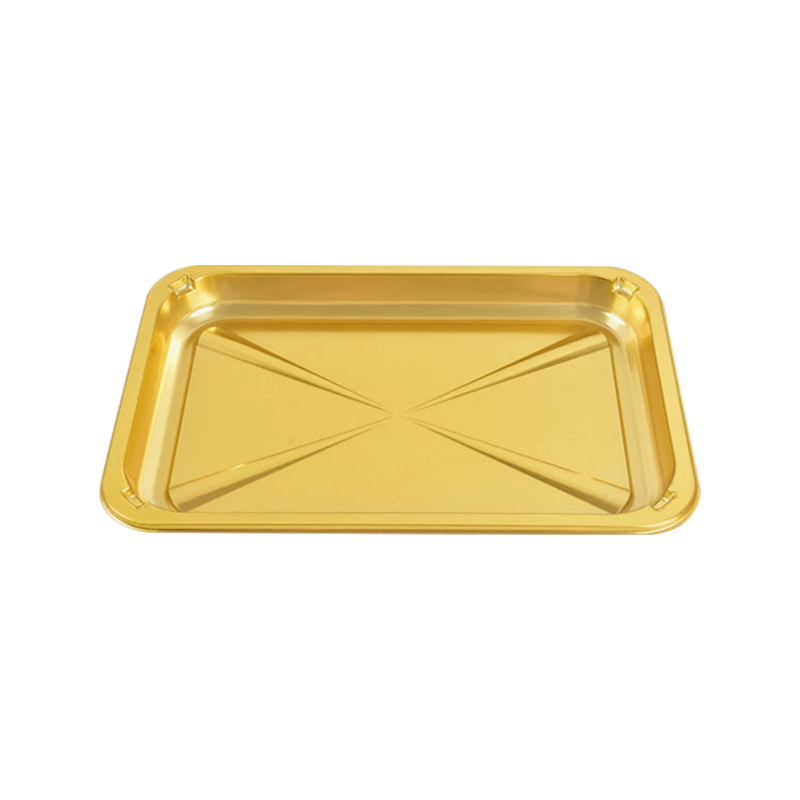 Food-Grade Disposable Frozen Food Packaging TrayA food-grade frozen food tray with a sealed design to limit air and moisture, suited to chilled and frozen packaging programmes.View Product →
Film, Atmosphere, and Sealing Method
Film choice follows the tray. Peelable films open cleanly for the customer; weld seals are stronger but demand matching materials. Anti-fog films matter for chilled displays where condensation would otherwise cloud the pack. High-barrier films are what make modified atmosphere worthwhile in the first place.
Three questions usually settle the film decision:
- Will the pack be reheated in the tray? If so, the film must tolerate the same temperature as the tray.
- Does the customer need a peel tab, or a fully peelable seal?
- Is the pack heading for a chiller, a freezer, or a warm display?
A mono-material pack — a PP tray with a PP-based lidding film — is far easier to recycle than a mixed structure. If sustainability targets are on the table, agree the material pairing before the machine is specified, not after.
Where Sealed Trays Earn Their Place on a Fast Food Menu
Sealing is not only for ready meals. In practice the format earns its place wherever a lid is fiddly, a leak is expensive, or a shelf-life claim needs backing:
- Chilled salads and cold bowls, where anti-fog film keeps the pack looking fresh.
- Rice, pasta, and hot ready meals, where a leak-proof seal survives delivery.
- Bakery and dessert items, where clear film shows the product without a dome.
- Fruit, sushi, and deli counters, where portion control and a neat finish matter.
- Frozen components, where a tight seal prevents freezer burn.
Multi-compartment formats are especially useful, because one sealed pack can hold a main and a side without mixing them in transit. You can browse the wider plastic food tray range to see how those shapes are usually grouped by material and application.
Two formats come up again and again in fast food work: a separated tray that keeps components apart under a single film, and a covered box built for hot, saucy food that will be reheated later.
 Multi-Compartment Separated Food Packaging TrayA PET tray with multiple compartments that keeps fast-food components separate, supports stacking, and offers air channels for freshness.View Product →
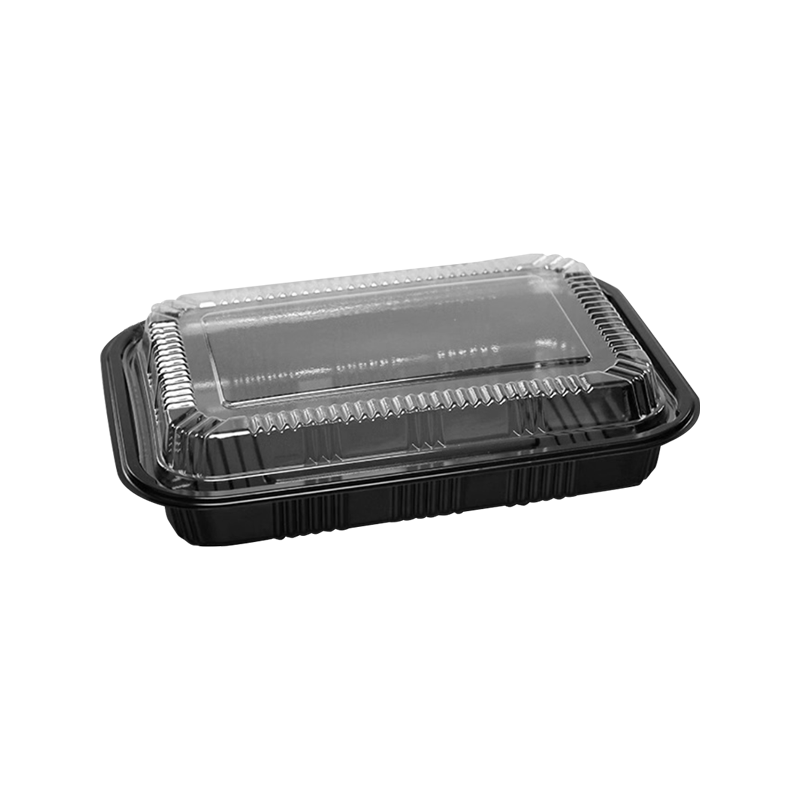 Microwave-Safe Anti-Overflow Covered Packaging BoxA black covered box designed to reduce steam overflow during microwave heating, suited to hot, saucy food in takeaway and food-service use.View Product →
Throughput, Changeover, and Total Cost
Machine comparisons usually start with trays per minute, but the number that matters is good packs per hour — after changeovers, jams, and rejected seals. Three cost lines deserve attention:
- Film versus lids. Lidding film is generally lighter and cheaper per pack than a rigid lid, and it stores flat.
- Labour. A sealed pack needs no lid placement, which removes a repetitive step from the line.
- Waste. Fewer mis-lids and fewer leaks mean fewer remakes and less giveaway.
Changeover is the quiet cost. Every tray footprint needs its own tooling, so a menu with six pack sizes needs six sets and a fast, repeatable way to swap them. Recipe storage on the controller helps, but only if the trays stay consistent from batch to batch.
Order tooling only after the tray is locked. A millimetre of flange difference between two tray suppliers is enough to force a new seal head — and a new lead time.
The steadiest sealing lines we have seen were not the fastest machines on the market. They were the ones where tray, film, and tooling had been agreed together, long before the purchase order.
Simple Seal Checks You Can Run In-House
You do not need a laboratory to catch most sealing faults. Four checks, run at the start of each shift, cover a lot of ground:
- Visual check. Look for wrinkles, incomplete seals, and film cut off-centre.
- Peel test. Pull the film back by hand at a steady rate; a good seal resists, then peels cleanly without tearing the flange.
- Dye penetration. Apply dye solution to the seal edge and look for wicking into the seal area.
- Pressure or vacuum check. Squeeze the pack gently, or place it under vacuum, and watch the corners for leaks.
Record the results. A pattern across a week tells you far more than a single pass or fail.
A sealing line that is checked at the start of every shift usually needs far less intervention by the end of it.
Bringing It Together
If you are specifying an automatic fast food tray sealer, work backwards from the pack. Decide the menu item, the shelf life, and the reheating method. Choose the tray material and the film as a pair. Confirm flange geometry with the tray supplier and the machine builder at the same time. Then order tooling.
Do that, and the machine will do what it appears to do in the demo videos: seal, cut, and keep moving. Skip it, and the line will teach you the same lesson more slowly — usually at the busiest hour of the day.



- The company requires rigorous, using a high starting point, trustworthy, quality, and actively develop and innovate, the pursuit of excellence route!
CONTACT US
- Tel: +86-15026677788
- E-mail: [email protected]
- Add: No.11 Huafeng Road, Anhua Community, Anhua Town, Zhuji City, Shaoxing, Zhejiang, China
GET A QUOTE
Copyright @ Donghang Polymer Material Technology Co., Ltd. All Rights Reserved.
 Custom PVC Blister Plastic Boxes Manufacturers
