


 English
 عربى
عربى Español
Plastic Food Tray Recycling: What Can Be Recycled and How the Process Works
Beyond the Chasing Arrows
Plastic Food Tray Recycling: What Works, What Fails, and Why
The takeout tray in your hand belongs to one of three polymer families — PET, PP, or PS — and that distinction determines whether it becomes a new product or a landfill resident.
Every evening, the same quiet dilemma plays out in kitchens and back-of-house counters: a used food tray sits on the counter, its base stamped with a recycling symbol, and the person holding it hesitates. The tray is greasy. The symbol suggests redemption. The local collection rules say no food residue. That hesitation is not ignorance. It is a reasonable response to a genuinely complicated system.
Plastic food tray recycling is not one process. It is a chain of decisions about polymer type, color, food residue, sorting machinery, and commodity markets. This guide explains how that chain works, where trays succeed, and where they almost always fail.
“Recyclable” Is a System Property, Not a Material Property
The fastest way to understand tray recycling is to stop thinking of recyclability as a fixed attribute. A PET tray is not recyclable the way glass is breakable. It is recyclable only when every link in the recovery chain cooperates: the sorting facility must identify the polymer, the wash line must remove food residue, and an end user must want the recovered material enough to buy it.
This explains the most common consumer complaint — the symbol is on the package, so why can't I recycle it? The chasing arrows identify the resin family. They do not guarantee that your municipality collects that resin, that the local processor has the equipment to detect it, or that there is a buyer for the recycled flake. Recycling is geographic. The identical tray is a valuable feedstock in one county and landfill trash in the next.
The Three Plastics Behind Most Food Trays
Food service and retail packaging rely on three thermoplastics. Each one has a different relationship with the recycling infrastructure.
PET — the one that works
PET (resin code 1) is the material of clear pastry displays, sushi platters, and high-visibility packaging. It is also the food tray plastic with the most realistic recovery pathway. Clear PET is easy for optical sorters to detect, sinks in float-sink separation, and has mature end markets in polyester fiber, strapping, and even new sheet. When a community accepts plastic food trays at all, clear PET trays are usually the first and most successful category.
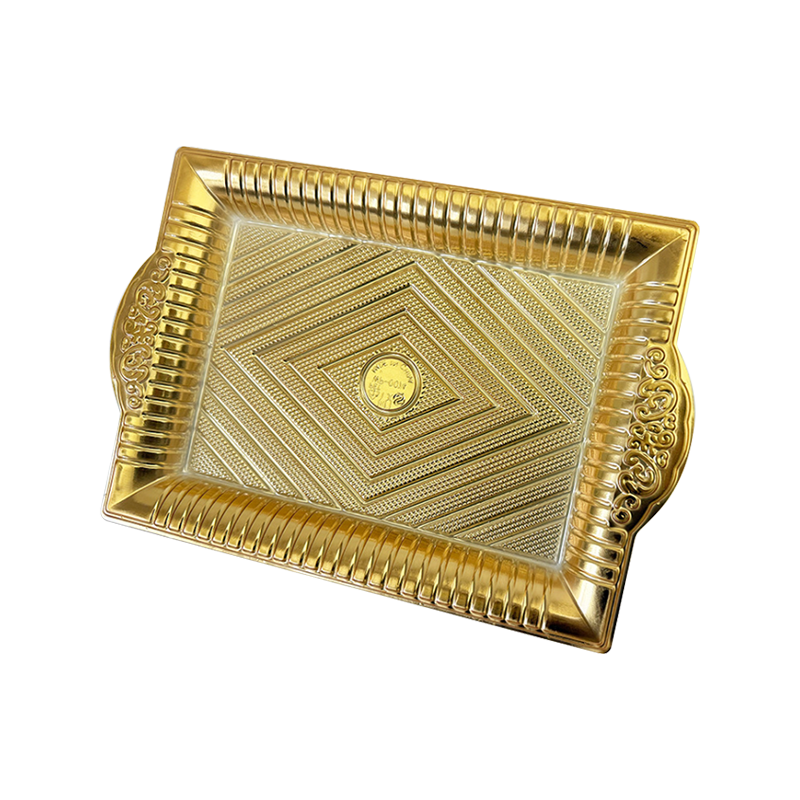 Clear PET Cake Vacuum TrayThis clear PET tray demonstrates the recyclability of resin code 1 packaging, while its minimal design helps optical sorters recover the material more effectively.View Product →
Design choices amplify or destroy this advantage. A clear PET cake tray with minimal decoration and no full-wrap label recovers far more easily than the same tray in a dark tint. The polymer was always recyclable; the product design decided whether it would be recovered.
PP — the improving workhorse
PP (resin code 5) is the material of microwaveable lunch trays, frozen food trays, and multi-compartment systems. For years, PP food trays were effectively unrecyclable. That has changed. Mechanical PP recycling has matured, and clear or light-colored PP trays now flow into crates, automotive components, and consumer goods. Dark-colored PP trays still fail sorting because the pigment hides the polymer from optical sensors. Frozen food packaging, almost always PP, is the clearest illustration: the resin survives reprocessing well, but the tray's color and printing determine whether a sorter will capture it at all.
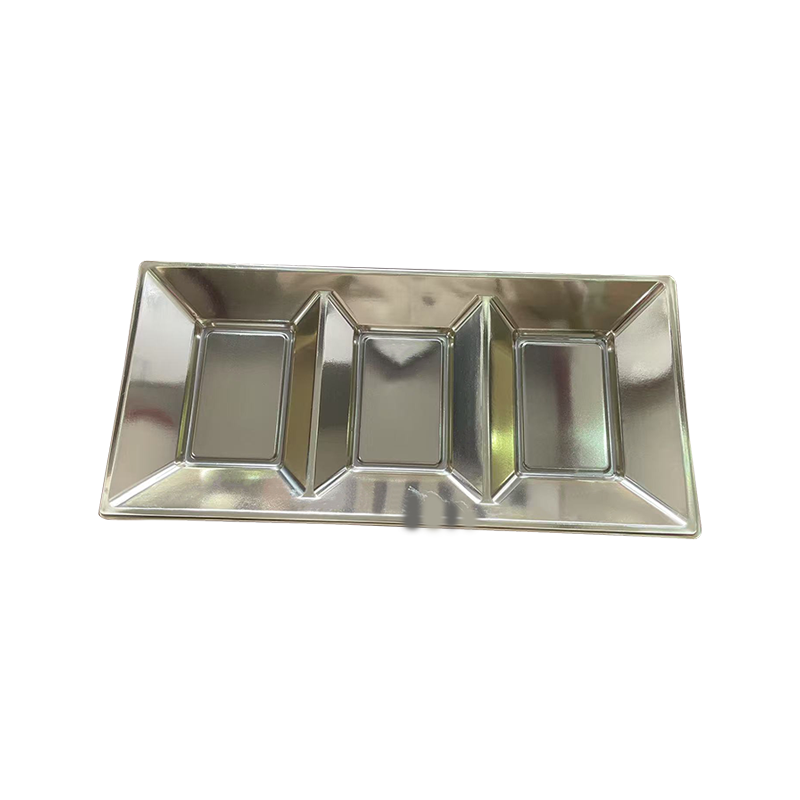 Silver Plastic 3-Grid Snack TrayA multi-compartment PP tray whose silver color may influence sorting efficiency, making it a relevant example of how light-colored PP supports recyclability.View Product →
PP sourcing decisions deserve particular attention. Resin grade, wall thickness, and color all influence both performance and end-of-life outcomes. A light-colored, single-material PP tray with a peelable lid is genuinely recyclable; the same tray in black with a welded lid is not. For a detailed look at how PP behaves across food tray applications, this material analysis covers the key trade-offs.
PS — the difficult case
PS (resin code 6) is the material of the black takeout tray, the deli tray, and many catering compartment trays. It is technically melt-reprocessable, but the economics rarely work. Dark pigment defeats near-infrared sorters, PS density is close to water which complicates sink-float separation, and end markets for recycled PS remain narrow. In practice, most PS food trays are landfilled.
| Polymer | Resin ID | Typical tray applications | End markets for recycled material | Real-world recovery outlook |
|---|---|---|---|---|
| PET | 1 | Clear pastry displays, sushi platters, produce trays | Polyester fiber, strapping, thermoform sheet | High where collected |
| PP | 5 | Microwave lunch trays, frozen food trays, multi-compartment systems | Crates, automotive components, pipe | Moderate and improving |
| PS | 6 | Black takeout trays, deli trays, catering compartment trays | Rare specialty applications | Low in most regions |
Read the code as a clue, not a verdict. A code 1 tray in a city without PET thermoform collection is trash. A code 5 tray in a facility with advanced near-infrared sorting may recover perfectly well. The resin code tells you what the tray is made of, not what will happen to it.
Food Residue Is the Silent Dealbreaker
Even a perfectly sorted PET tray fails if it carries food waste. Reprocessors consistently say the same thing: a tray with visible residue contaminates the entire bale. When contamination pushes a load above the accepted threshold, the batch is downgraded to lower-value applications or rejected outright. One greasy tray can reduce the value of thousands of pounds of clean material.
The question is not whether a tray looks recyclable. The question is whether a sorting machine can see it, a wash line can clean it, and a manufacturer can sell it.
This is why “empty and rinse” is not a polite suggestion. It is an economic necessity. The target is no visible food, not a sterile surface. A quick scrape and wipe is enough; industrial wash lines handle the deeper cleaning.
Contamination limits are tight. Reprocessors hold incoming bales to strict food-residue thresholds. A load that exceeds the limit is rejected or heavily discounted, which is why one dirty tray can wipe out the value of an entire shipment.
What Happens Inside a Recycling Facility
Plastic food tray recycling follows a sequence that is consistent across modern facilities:
- Collection. Trays arrive at a materials recovery facility mixed with bottles, cans, paper, and the rest of the recycling stream.
- Primary separation. Screens and manual pickers split two-dimensional materials from containers and remove obvious contaminants.
- Optical sorting. Near-infrared sensors read the polymer signature of each item. This is where PET splits from PP — and where black PS trays become invisible to the machinery.
- Baling. Sorted plastics are compacted into dense bales and sold to reprocessors.
- Grinding. The bales are shredded into flake.
- Washing and sink-float separation. Water, heat, and mild chemistry strip labels, adhesives, and food residue, and density differences separate PET from polyolefins.
- Melt reprocessing. The clean flake is extruded and pelletized into raw material for new products.
Every step includes a quality gate. Consistency of color, viscosity, and contamination determines the price a reprocessor can command. This is why recent work on depolymerization and solvent-based purification matters so much for plastic food tray recycling: methods that break polymers back into virgin-quality monomers would bypass several of these gates and turn today's unrecyclable trays into tomorrow's raw material.
The Tray Designer Is Also a Recycler
Most people assume recycling is created or destroyed at the curb. In reality, the most consequential decisions happen long before the tray exists. A packaging engineer chooses the polymer, wall thickness, color, label, adhesive, and lid mechanism. Every choice either helps or destroys the tray's chance of recovery.
Mono-material design is the clearest lever. A PET body with a PET lid and no paper label recovers far better than a PET base with a PP lid and a paper label. Color choice is just as decisive: the black pigment that defeats optical sorters is a design decision, not a functional necessity. Switch to light gray or natural beige, and a tray with identical mechanical performance becomes sortable.
The industry is responding. Sheet suppliers now offer transparent PET grades with higher post-consumer recycled content. Near-infrared sorting has become accurate enough to separate light-colored trays into monetizable streams. And some food brands now require recyclability documentation from packaging suppliers at the procurement stage, instead of discovering the tray's end-of-life fate after launch.
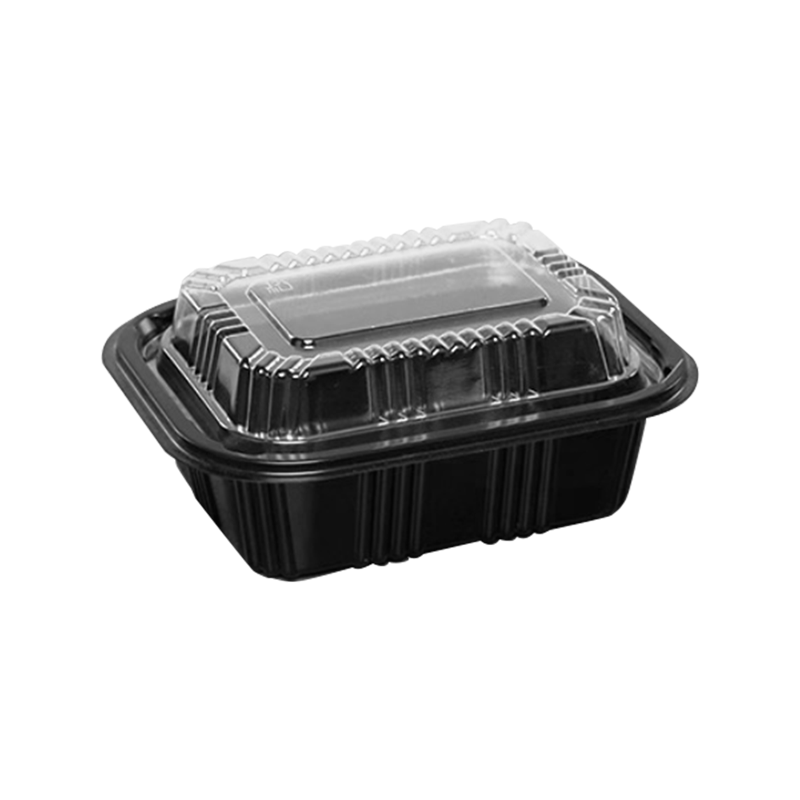 Disposable Eco-Friendly Vacuum Formed TrayThis mono-material vacuum-formed tray with reinforced edges and ribbed base suits a range of foods, reflecting industry moves toward more recoverable packaging design.View Product →
A vacuum-formed tray designed for recovery — mono-material, light color, minimal label surface — is not a contradiction. It is the difference between participating in a circular economy and merely borrowing its language.
What a recyclable tray looks like: light or clear color, single polymer, minimal printing, removable labels, no attached film, and a resin code that matches what your local program actually collects.
What to Do With the Tray on Your Counter
For households and food businesses alike, five rules cover most plastic food tray recycling decisions:
- Check the resin code, but do not stop there. Clear code 1 and light-colored code 5 trays are the best recycling prospects. Code 6 and any dark tray are likely trash in most municipalities.
- Empty and wipe the tray. Visible food residue is the fastest way to turn a recyclable tray into garbage.
- Remove absorbent pads, film lids, and attached components. Different materials contaminate the stream.
- Follow local program instructions. Sorting equipment varies by region, and some programs accept PP trays that others reject.
- When buying packaging, favor clear or light colors, mono-material constructions, and labels that peel cleanly.
Black trays are the exception. Even when black trays carry a recycling symbol, most curbside programs cannot process them because the dark pigment blocks the optical sensors used in sorting. Assume black trays are non-recyclable unless your community confirms otherwise.
The Chain Is the System
Plastic food tray recycling will never be as simple as dropping a clean bottle into a bin. Trays are thinner, more colored, more contaminated, and more often made of the polymer that recovery systems handle least well. But the system is not stationary. Near-infrared sorting is improving, PP recovery is expanding, and more packaging buyers now treat recyclability as a contract requirement rather than a marketing aspiration.
The chain from tray to new material runs through design, collection, sorting, washing, and reprocessing. Every link can be strengthened. The question for any packaging decision is not “is this tray recyclable?” but “what would need to be true for this tray to be recycled?” The manufacturers that answer honestly, and design accordingly, are the ones that will still be packaging food a decade from now.



- The company requires rigorous, using a high starting point, trustworthy, quality, and actively develop and innovate, the pursuit of excellence route!
CONTACT US
- Tel: +86-15026677788
- E-mail: [email protected]
- Add: No.11 Huafeng Road, Anhua Community, Anhua Town, Zhuji City, Shaoxing, Zhejiang, China
GET A QUOTE
Copyright @ Donghang Polymer Material Technology Co., Ltd. All Rights Reserved.
 Custom PVC Blister Plastic Boxes Manufacturers
