Large Plastic Food Transport Trays: Where Bulk Orders Actually Go Wrong
Most large trays are not rejected because the resin was cheap. They are rejected because the specification was written for a shelf, not for the eight hours the tray spends in a cold truck.
A large plastic food transport tray is a load-bearing object. That single distinction explains almost every failure that surfaces three weeks after a bulk order lands: corner cracks on frozen dough trays, lids that no longer snap shut on pastry trays, and base panels that bow far enough to spill sauce across a pallet.
So here is the conclusion before the reasoning. Three variables decide whether a large tray survives its first month in service: the polymer, the rib and corner geometry, and the lid tolerance stack-up. Unit price comes fourth. Buyers who invert that order tend to pay twice, once on the invoice and again on the replacement shipment.
What "Large" Really Means on a Transport Route
On a production line, tray size is a tooling question. On a delivery route, it is a handling question. The same 600 x 400 mm footprint that looks efficient on a pallet becomes awkward the moment a driver has to carry it up six steps alone, one-handed, while the contents are still warm.
Before any drawing is approved, work backwards from the route itself. How far does the tray travel? How many times is it lifted by hand? What sits on top of it in the van? Will it ever be moved while the contents are still above ambient temperature? The answers change the specification far more than a price comparison does.
Three route profiles cover most orders placed in this category:
- Single-trip delivery. The tray leaves the plant once and is discarded. Stacking density and unit cost dominate the decision.
- Returnable loop. The tray is washed, stacked and reused a dozen times or more. Rim strength and nesting ratio matter more than price per gram.
- Cross-temperature routing. Product is packed warm, chilled overnight, then loaded into an unheated van in winter. This is the harshest case, and the one that exposes brittle resins fastest.
PP, PET and PS: The Cold-Chain Reality Behind the Resin Choice
Most buyers compare resins on a price sheet before they compare them on a loading dock. The order is backwards. An eight-kilogram frozen meal load is never spread evenly across a wide base; it concentrates over four or five contact points, and those points sit in an unheated trailer for hours at a time.
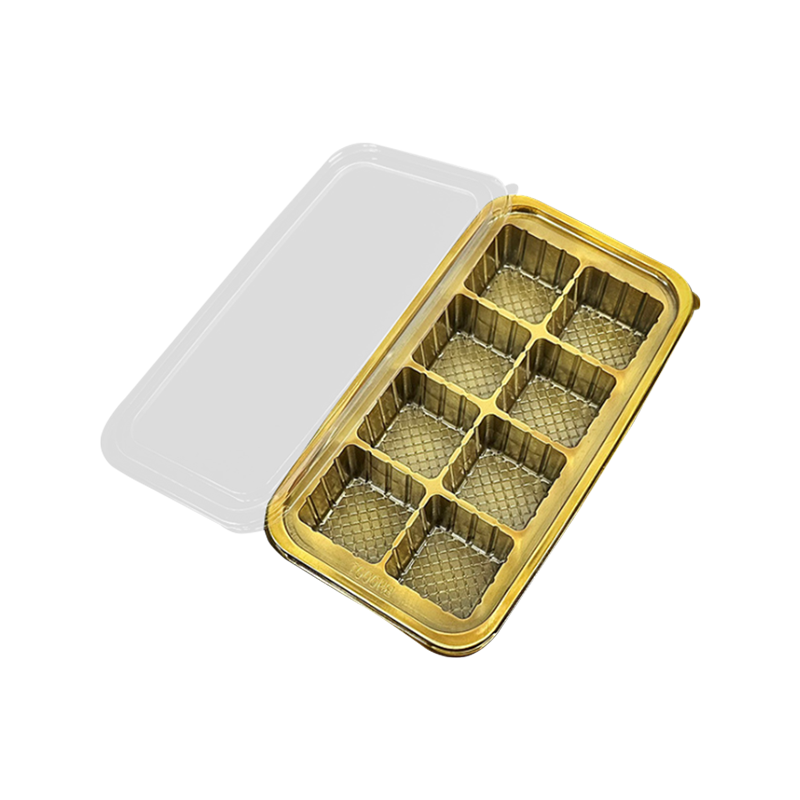
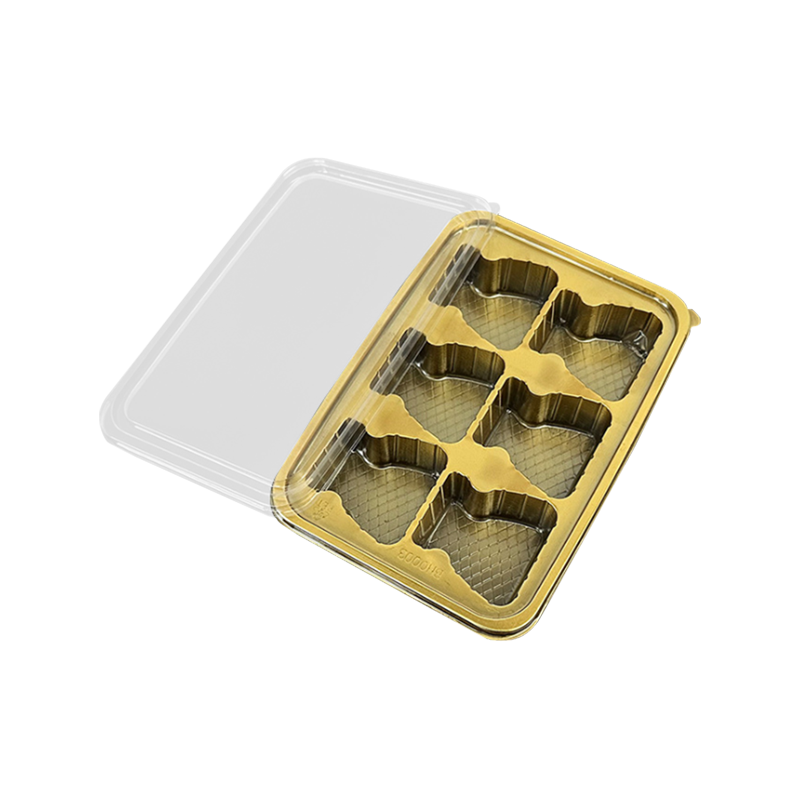
PP is the default for that reason. It retains most of its impact strength down to roughly minus 18 degrees Celsius, which means a dropped corner chips rather than shatters. PET holds a genuine advantage in clarity and stiffness, which is why chilled pastry and sushi platters still rely on it, but the same tray becomes noticeably more brittle as temperature falls. PS sits at the other end of the scale: crisp, easy to tint in gold or silver, and quick to crack at the rim during rough handling.
Practical comparison of the three resins used in large food transport trays; actual performance depends on wall thickness, rib layout and tray depth.
| Resin |
Behaviour below 0 degrees Celsius |
Optical result |
Best fit in large transport trays |
| PP |
Keeps most impact strength; resists cracking when dropped from pallet height |
Semi-transparent to opaque |
Frozen dough, prepared meals, chilled meal components |
| PET |
Stiff and clear, but noticeably more brittle as temperature drops |
High clarity |
Chilled pastry, sushi platters, display-grade trays |
| PS |
The most brittle of the three; edge chips appear quickly under handling |
Clear, or easily tinted in gold and silver |
Ambient candy and dry goods moved in mild conditions |
The trade-offs between rigidity, clarity and low-temperature toughness are covered in more depth in our breakdown of PP food tray material characteristics, including the cases where a blended approach makes more sense than a single resin.
Danger: A tray that passes a room-temperature drop test can still fail a frozen one. If any leg of the route runs below freezing, test the actual tray at the actual temperature before releasing the tooling.
Rib Geometry, Corner Radius and the Stacking Load
Wall thickness is the least interesting variable in a large tray. Two trays formed from sheet of the same gauge can differ by a wide margin in stiffness once the rib pattern changes, because rigidity in a transport tray comes from depth and continuity rather than from mass.
Three design habits show up repeatedly in trays that survive real distribution:
- Ribs are placed across the short span, where they add the most resistance for the least material.
- Corners carry a generous radius. Sharp internal corners concentrate stress exactly where a hand grips the tray.
- The rim is returned or folded rather than left as a bare edge, which resists the sideways squeeze that happens when two people carry one loaded tray.
Stacking is the other half of the equation. Nesting ratio decides how many empty trays fit on a return pallet, and a deep nest usually means a thinner wall that flexes under load. Buyers who optimise only for freight density often discover that trade-off on the first production run.
Warning: Specifying a large tray by wall thickness and unit price alone is the most common procurement mistake in this category. Two trays with identical wall thickness can differ by a factor of two in stiffness once the rib layout changes.
Lids, Anti-Fog and the Tolerance Stack-Up Nobody Budgets For
A lid that clicks shut at 20 degrees Celsius is not proof that it will click shut at 4 degrees. Thermoformed parts move with temperature, and the lid and the base come from two separate moulds with two separate tolerance ranges. That gap is where most field complaints originate.
Anti-fog performance follows the same logic. A fogged lid does not spoil food, but it makes a chilled salad or a fruit platter look tired on the shelf, and retail buyers tend to notice within a week. The treatment has to be specified on the sheet before forming, not applied afterwards.
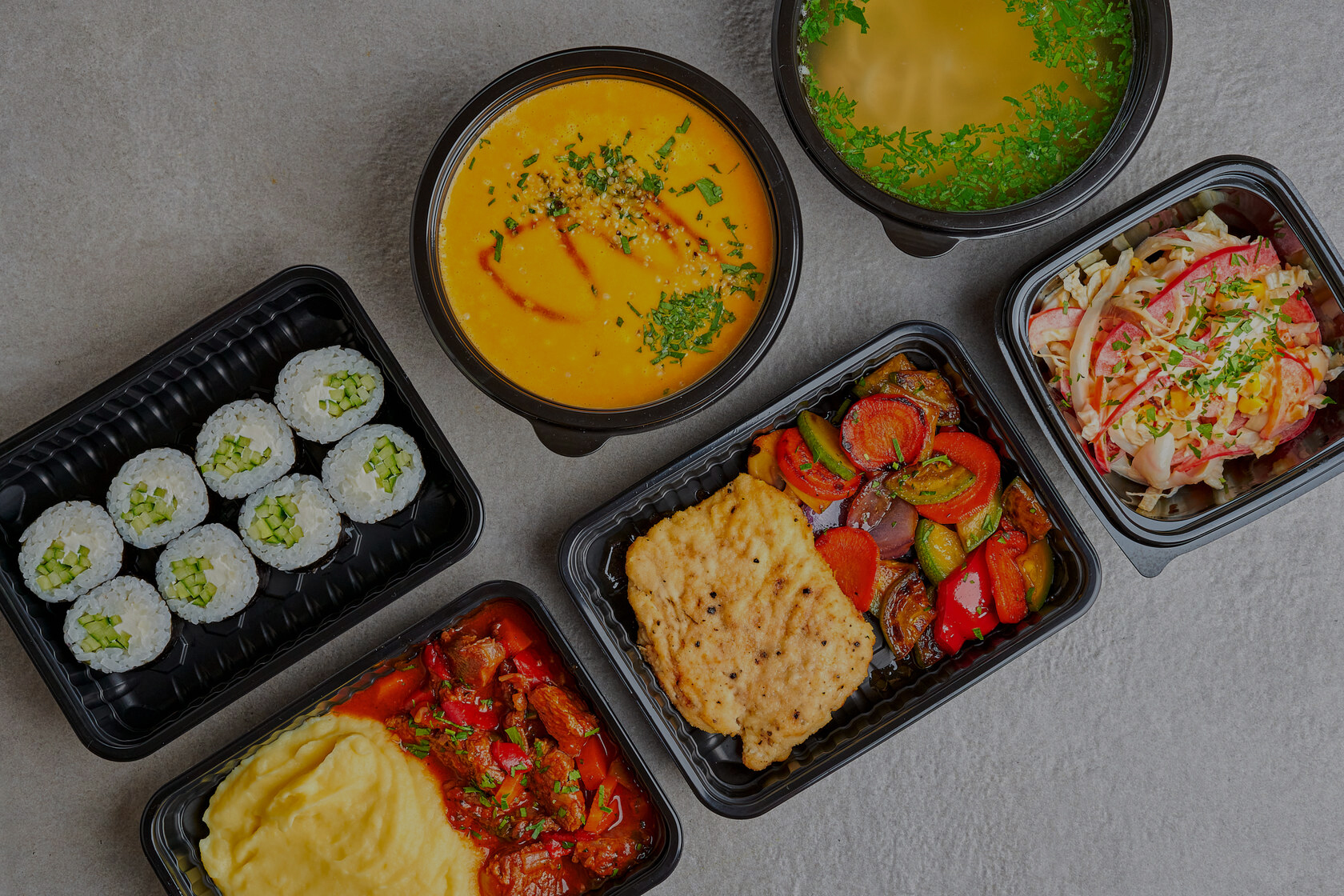
For trays that carry several components at once, compartment depth and wall draft deserve the same scrutiny as the outer rim. A divider that is 2 mm too shallow lets sauces migrate between sections during a bumpy delivery, and no amount of careful packing downstream will fix it.
Success: Pairing an anti-fog lid with a tray that has a defined condensation channel keeps the viewing window clear for the full chilled shelf life, which is usually the difference between a repeat order and a rejected batch.
Food Contact, Hygiene and Multi-Stop Distribution
Once a tray leaves the plant, it is handled by people who have never read the specification. That is the practical argument for keeping the design simple: fewer recesses, fewer sharp internal transitions and fewer places where residue can sit after washing.
For food-contact compliance, the useful questions are concrete rather than philosophical. Which resin grade is declared for direct contact? Is the same grade used across every cavity of a multi-cavity tool? Can the supplier trace a shipment back to the sheet batch if a customer raises a query six months later?
Info: Tooling design, sample approval and volume production are best handled by one supplier. Splitting the mould between one vendor and the forming between another is the fastest way to lose traceability when a tolerance question arises.
A Specification Checklist Before You Approve Tooling
Work through these points in order. Each one has a direct cost implication, and skipping any of them usually reappears as a quality claim later.
- Confirm the loaded weight and how it is distributed across the base, not just the total.
- Record the lowest temperature the tray will experience, including transit, not only storage.
- Decide whether the tray is single-trip or returnable, because that sets the rim requirement.
- Measure the stacking height on the pallet, loaded and empty, and check the nesting ratio.
- Define the lid fit as a measurable value rather than "snug", and state the test temperature.
- Specify whether anti-fog, anti-overflow or microwave suitability is required, and on which part.
- Agree on the sample approval process and the number of revision cycles included.
- Confirm the packaging format for delivery, since tray-on-tray stacking during freight can pre-stress the rims.
Material Reduction, Recycling and What Buyers Ask For Now
Down-gauging is the most common sustainability request in this category, and it is also the easiest one to get wrong. Removing material from a panel that already deflects under load simply moves the failure from the QA bench to the customer's loading bay.
The more durable approach is to reduce material where it does no structural work, such as the flat field between ribs, and to keep it where load concentrates. Monolithic PP constructions also end their life more cleanly than laminated ones, which matters for customers with recycling commitments written into their own supply contracts.
A tray that has to look good on a shelf and survive a freezer aisle is a different product from a tray that only has to survive a freezer aisle. Trying to buy one part for both jobs is where most of the money is lost.
What to Do Next
Start with the route, not the catalogue. Write down how far the tray travels, how cold it gets, how heavy it is when loaded and how many times it is handled. That brief will narrow the resin, the rib layout and the lid design faster than any comparison table can.
From there, ask for a physical sample formed on the intended tooling, test it at the real temperature with the real load, and only then commit to volume. A large plastic food transport tray is a small line item against the cost of a rejected delivery, and the difference between the two is usually settled long before the purchase order is signed.



 English
 عربى
عربى Español






 Custom PVC Blister Plastic Boxes Manufacturers
