


 English
 عربى
 Español
High Quality Plastic Tray for Frozen Food: Resin, Design and Cold-Chain Notes
Frozen Food Packaging · Material and Design Notes
The High Quality Plastic Tray for Frozen Food: Cold, Clear, Quietly Engineered
A frozen tray has to survive -18 °C, months in a chest freezer and the moment a shopper picks it up. Everything else is detail — but the detail is where a tray is won or lost.
What the Freezer Actually Does to Plastic
A frozen food factory in winter is a good place to learn humility about packaging. The tray that formed beautifully in July is suddenly stiff on the line in December, and corners that survived a hundred pallet drops in summer start to craze after a single one in the cold. At -18 °C most thermoplastics lose a noticeable amount of impact tolerance, and the grades with the least room for error will tell you so at the worst possible moment — usually during fast de-nesting or a stacked pallet shift.
Then there is what the shopper sees. A tray can spend months moving between freezer and display, gaining and losing a thin skin of condensation every time a door opens. A lid that fogs over makes a carefully made product look tired, and no amount of good formulation inside the pack will repair that first impression. Anti-fog behaviour and clean transparency are merchandising decisions as much as technical ones.
Finally, load. Frozen product is dense. A tray that carries 500 g at room temperature may be asked to hold six of itself in a cold store, and the base, the ribs and the corner radii decide whether that stack is still square after a month.
Choosing the Resin: PP, PET and PS in the Cold
Three thermoplastics do most of the work in this category, and each has a distinct personality below zero. The comparison below is the one we tend to walk through with customers before any tooling conversation begins.
| Resin | Behaviour in the freezer | Reheating | Usually chosen for |
|---|---|---|---|
| PP | Tough and flexible; tolerates drops and flexing; translucent to opaque | Microwave and hot-fill friendly | Frozen meals, dumplings, seafood, sauces, vacuum-packed blocks |
| PET | Rigid and crisp with high clarity; can crack under sharp impact in deep cold | Not for high heat | Frozen bakery, fruit, cold desserts, display-led retail |
| PS | Stiff, inexpensive and very clear, but noticeably brittle at freezer temperatures | Not suitable | Short chill, dry frozen items, low-stress display |
None of this is a ranking. A PET tray that lets a shopper see frozen berries through a window is doing something a PP tray cannot, and a PP tray holding a saucy ready meal is doing something PS would fail at within a season. For readers who want the underlying material behaviour, this analysis of PP plastic food tray characteristics goes deeper than a table can.
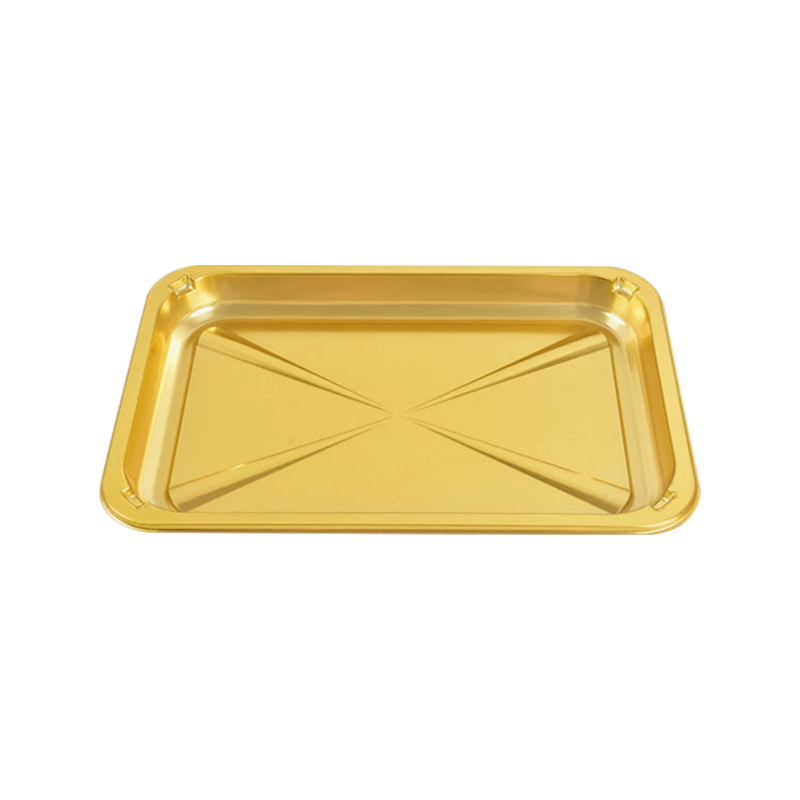 Gold PP Frozen Food Packaging TrayA reusable, food-grade PP tray for frozen meat, fish, vegetables, fruits, and cooked food, with a sealed design and stackable format for wholesale use.View Product →
Why PP carries most of the frozen category
Polypropylene earns its place for unglamorous reasons. It keeps a useful amount of toughness well below zero, it tolerates reheating, and it accepts the ribs and thin sections that make a tray economical to form without turning brittle. The trade-off is clarity: PP is translucent at best, so if the product needs to be seen rather than described, a clear lid or a PET window usually enters the drawing at some point.
Most of the frozen trays we form are PP. A thin wall cools quickly, cycles fast and keeps material cost down — but that wall cannot be thinned past the point where the corner stops supporting the stack. Finding that line is most of the engineering work.
Where the Tray Design Decides the Outcome
Wall thickness, ribs and the illusion of strength
Adding grams is the expensive way to make a tray feel solid. Adding ribs, a proper corner radius and a slight taper usually achieves more, at lower material cost and with a faster cycle. The rule we keep returning to: thicken where the load turns, thin where it only travels.
Lids and sealing at freezer temperature
A lid that clicks shut on a warm line at 20 °C is not the same lid at -18 °C. Base and lid shrink at slightly different rates when they are made from different resins, and a snap feature tuned at room temperature can loosen in storage. Whenever a hinged or separate lid matters, the closed pack should be tested at temperature rather than on the bench.
Vacuum sealing and the flat surface
Vacuum film is unforgiving about geometry. A base with a slight crown — invisible in a drawing — can load the film unevenly and cause a puncture or a slow leak that only appears after transit. Frozen blocks destined for vacuum packing usually want a genuinely flat floor, generous radii and no sharp internal step for the film to climb.
 Gold PP Vacuum-Sealed Frozen Food Packaging BoxA gold PP box for frozen-food packaging, using vacuum sealing to limit oxygen and moisture while keeping contents stable in refrigerated and frozen conditions.View Product →
Stacking, de-nesting and line speed
Nesting force is a design variable, not an accident. Trays that grip each other too firmly slow a suction-cup de-nester; trays that barely nest waste cube space in the case. Static is the quiet third factor — dry, cold air plus thin PP is a good environment for trays that refuse to separate, and a different surface texture or a small antistatic additive often settles it for good.
In our experience, most frozen tray complaints trace back not to the resin but to a corner radius chosen in a CAD file three months before the first production run.
Matching the Format to the Food
Frozen food is not one category, and the tray that suits dumplings rarely suits berries. These are the segments we form for most often, and what each one asks of the packaging.
- Frozen dumplings, buns and dim sum — compartment counts that keep pieces apart, plus a lid that stays clear rather than fogging over.
- Frozen seafood and portioned fish — flat, drainable bases and a footprint that stacks squarely in a cold store.
- Prepared meals and sauces — leak-resistant seams, microwave tolerance and a wall stiff enough to lift while hot.
- Frozen dough, pastry and part-baked bread — a rigid base that holds shape as the dough expands, with no sharp step to catch film.
- Frozen fruit and berries — clarity where the product is the argument, and a base that tolerates a wet fill line.
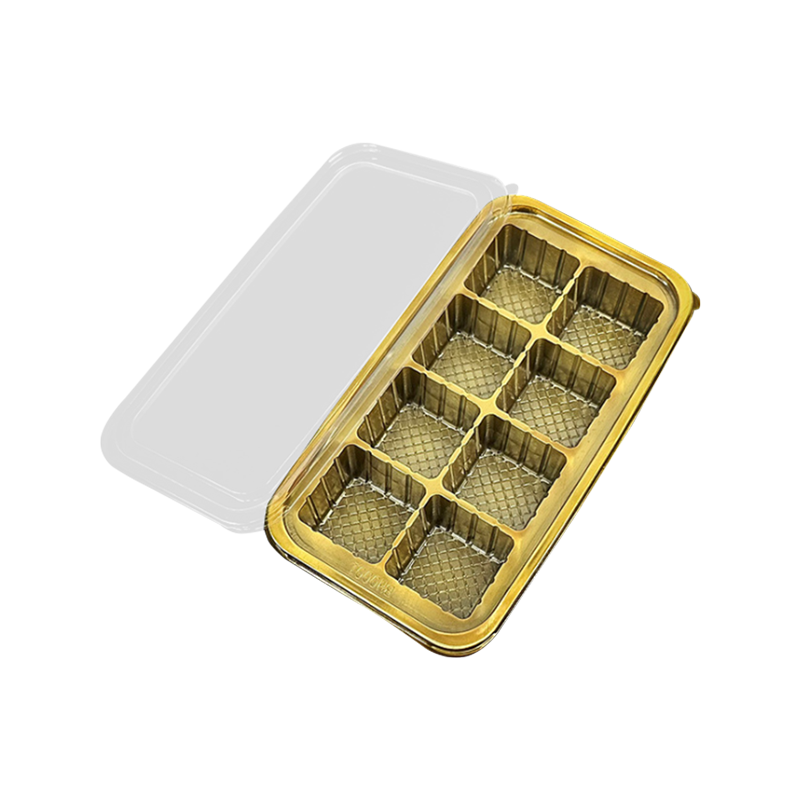
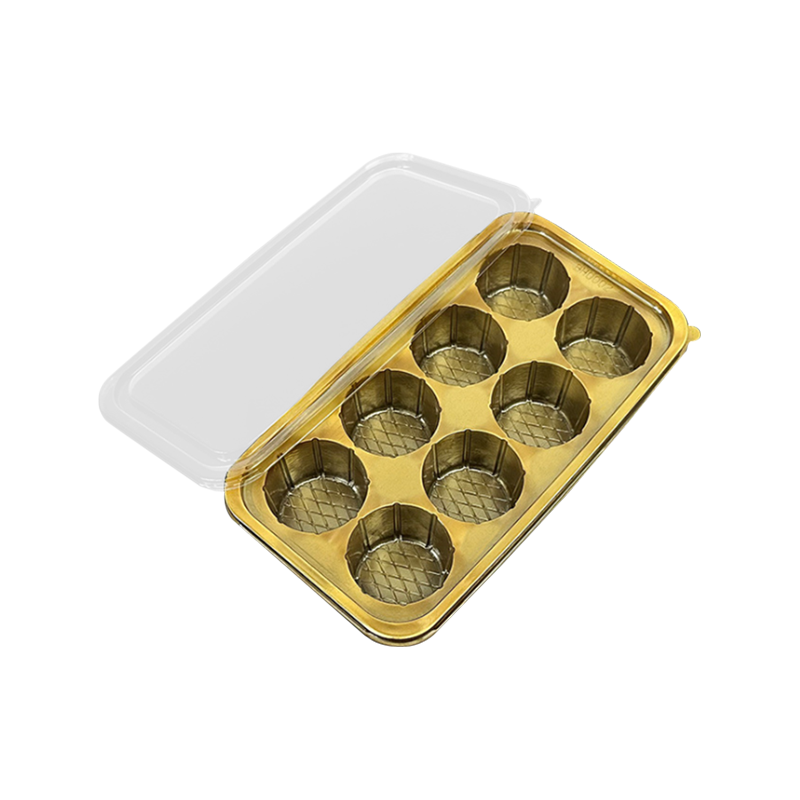
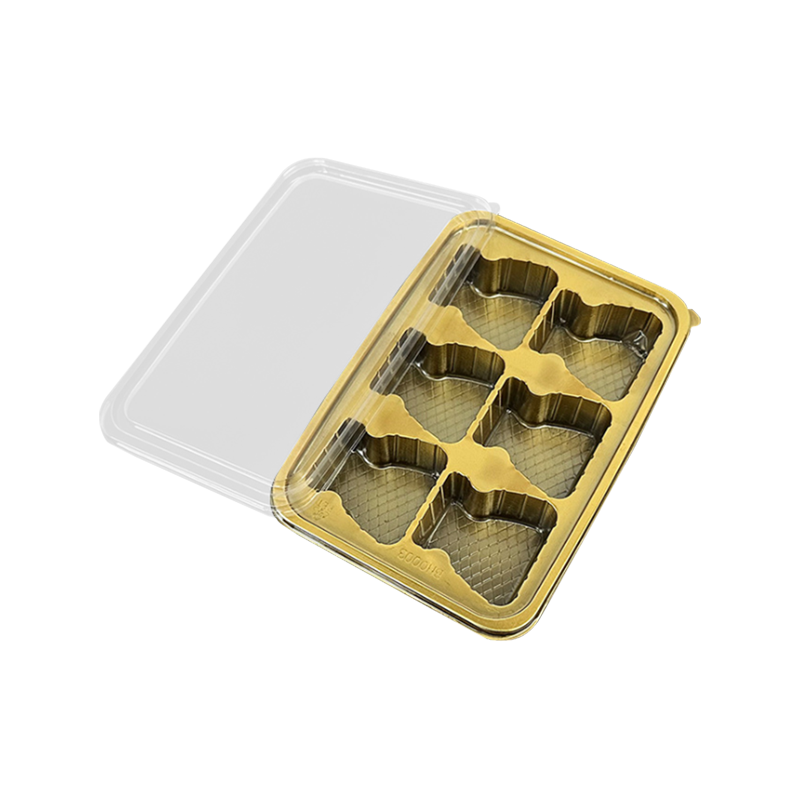
- Chocolate, inclusions and dessert components — small cavities, clean release and a finish that still reads well in low light.
Much of this work — especially bakery and prepared-meal formats — sits close to our PP plastic food tray range, where a single tool can often serve several products with a change of cavity layout.
 PET Disposable Baking and Vacuum-Forming TrayA PET baking tray in black/gold that withstands high heat, supports even distribution, and doubles as secure retail packaging for baked goods and prepared foods.View Product →
One geometry can go a long way. A vacuum-formed tray developed for frozen dough will usually handle part-baked bread as well, provided the wall and rib pattern were chosen for the heavier of the two. That kind of reuse is worth planning for at the drawing stage, because it is very hard to retrofit later.
Questions Worth Asking Before a Mold Is Cut
Before tooling starts, six questions tend to save more money than any negotiation on unit price.
- What does the pack weigh, and how high will it be stacked? Stack height, not product weight, usually sets the base thickness.
- What is the lowest temperature the tray will meet, and for how long? A blast freezer at -35 °C is a different brief from a -18 °C display case.
- How will the food be reheated — microwave, oven, or not at all? This single answer admits or removes whole resin families.
- Is there a lid, a film seal, or a sleeve? The lidding method decides flange width, flatness tolerance and often the resin itself.
- How does the tray move on your line? De-nesting, static, conveyor speed and drop height all leave marks on the design.
- What does the label need? Print areas, wrap-around labels and embossed logos compete for the same flat surfaces.
Test at temperature, not on the bench. A tray that seals, stacks and releases perfectly at 20 °C can behave like a different product after a night at -18 °C. Pull samples out of the freezer before you sign anything off.
A sampling note from our side: for a new frozen format we usually begin with a single-cavity tool, freeze the samples, then adjust ribs or radii before committing to multi-cavity production. It adds one step and almost always removes two.
The Unfashionable Case for Doing Less
The most sustainable tray is usually the one with less material in it, formed from a single resin, that does not need a laminated film to perform. Mono-material PP formats are simpler to sort and recycle than mixed constructions, and a well-ribbed 0.6 mm wall can outperform a flat 1.0 mm one while using a third less plastic. None of that asks for a new material — only a better drawing.
Where a brief allows it, we design toward mono-material trays with mechanical closures instead of adhesive lamination, because end of life is decided at the design stage, long before the pack reaches a sorting line.
The tray is the part of a frozen product that nobody praises and everybody notices when it fails. Get the resin right, keep material where the load turns, test at temperature, and the packaging stops being a conversation — which is exactly what good packaging should do.
If you are working through a frozen format now, we are glad to look at the drawing, the stack height and the freezer temperature with you before anything is cut. That conversation is almost always shorter than the mold revision it prevents.



- The company requires rigorous, using a high starting point, trustworthy, quality, and actively develop and innovate, the pursuit of excellence route!
CONTACT US
- Tel: +86-15026677788
- E-mail: [email protected]
- Add: No.11 Huafeng Road, Anhua Community, Anhua Town, Zhuji City, Shaoxing, Zhejiang, China
GET A QUOTE
Copyright @ Donghang Polymer Material Technology Co., Ltd. All Rights Reserved.
 Custom PVC Blister Plastic Boxes Manufacturers
