


 English
 عربى
 Español
How to Choose a Plastic Tray for Ready to Eat Food: Materials and Design
When a ready-to-eat counter doubles its order volume, the tray stops being an afterthought. It has to protect the food, present it on the shelf, survive the delivery route and still look clean when the customer lifts the lid. For buyers in food production, catering and retail, choosing a plastic tray for ready to eat food usually comes down to three questions: which material, which design features, and which factory can deliver both consistently.
The decision is more structured than it first appears. Almost every ready-to-eat application fits one of three thermoplastics — PET, PP or PS — and once the material is settled, the tray type, closure and surface treatment follow from the food itself.
Start with the job the tray has to do
Material selection only works when it is anchored to the food's actual conditions at the moment of packing. Ask four questions before looking at any sample:
- At what temperature is the food packed — hot, chilled or frozen?
- Is the product moist, oily or dry?
- Will it travel, sit under a heat lamp, or go straight into a fridge?
- Does the customer reheat the food in the container?
The answers immediately narrow the field. Hot food rules out PS and favours PP. Cold display with strong visual appeal points to PET. Frozen storage demands low-temperature impact resistance and dimensional stability.
PET, PP or PS: the material sets the limits
Once the job is defined, the comparison table becomes a practical tool rather than a specification sheet. The three materials dominate ready-to-eat packaging because thermoforming lets them produce lightweight, repeatable trays at high volume.
| Property | PET | PP | PS |
|---|---|---|---|
| Typical temperature range | -20°C to 60°C | -20°C to 120°C | -10°C to 70°C |
| Clarity | Excellent, glass-like | Translucent, can be coloured | Good, often hazy |
| Strength | Rigid and impact-resistant | Tough, flexible, fatigue-resistant | Rigid but brittle |
| Best suited to | Cold display: pastry, sushi, fruit | Hot meals, frozen food, reheating | Short-shelf cold items, budget packs |
PET gives the clearest window onto the product, which is why it leads in bakery and sushi presentation. The plastic food tray range at Donghang reflects this: clear PET trays are designed for products that have to sell themselves through the packaging.
PP behaves differently. It withstands higher temperatures, survives microwave reheating without distortion, and holds its shape when the food inside is heavy or moist. Frozen food processors also favour PP because it stays ductile at low temperatures. The material's trade-offs are examined in more depth in our analysis of PP food tray material characteristics.
There is also a growing conversation about rPET and other recycled feedstocks. Recycled-content trays can work well for chilled categories, but every recycling stream changes the polymer slightly, so the material grade must be verified before committing to a large order.
Design details that decide the customer experience
Material sets the limit; design determines the moment of truth when the customer opens the lid. Four details matter most in ready-to-eat packaging.
“The tray is the first packaging the customer touches. If it fogs, leaks or looks cheap, everything inside it feels cheap too.”
Anti-fog surface treatment
A tray of chilled sushi or salad inside a sealed lid is a condensation problem. When warm, humid air hits the cold lid, droplets form and the product becomes unreadable. Anti-fog treatment spreads the moisture into a thin transparent film instead of beaded droplets.
Anti-overflow and sealing
Delivery boxes with broth, sauces or marinated items need a tray and lid combination that resists leakage when tilted. Anti-overflow designs use raised rims, tight-fit buckles and sometimes a sealing bead around the lip.
Compartments and portioning
A multi-compartment tray keeps the rice, protein and garnish separate and preserves each component's texture. In bento and meal-prep formats, the compartment layout also controls portion cost.
Stacking and lid geometry
Stackable trays save fridge and delivery space. A dome lid adds headroom for tall items, while a low-profile lid suits pre-packed sandwiches and pastries.
Match the tray to what you sell
The application is the fastest guide to the right tray. Different product categories demand different priorities.
Bakery and pastry: display first
Cakes, pastries and desserts sell on appearance. Transparent PET trays with vacuum-formed bases hold the product securely while making the decoration visible from every angle. A thicker base also stops the tray from flexing when the cake is heavy.
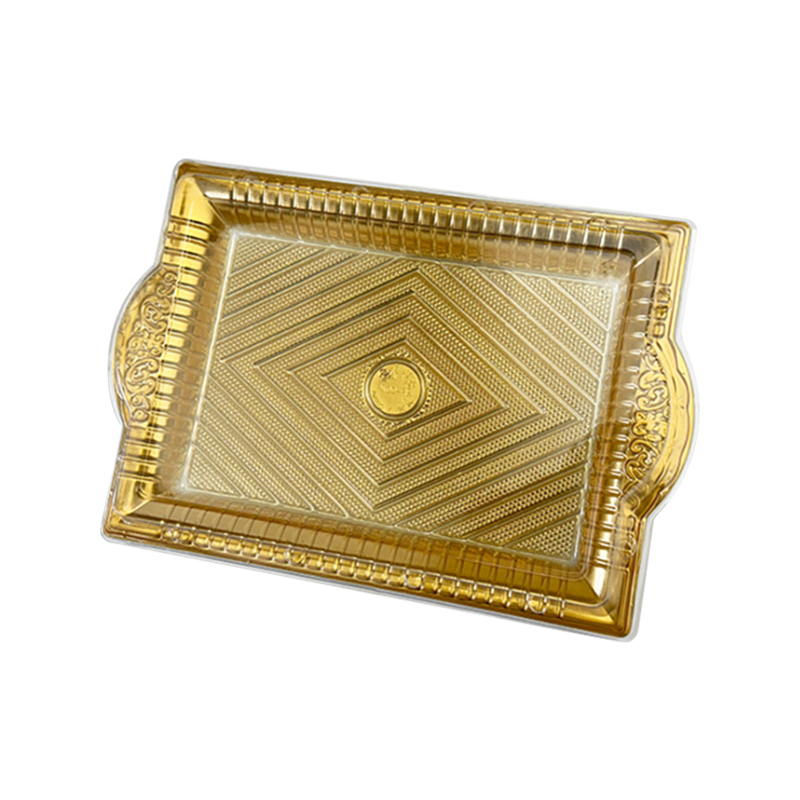 透明加厚PET糕点托盘这款金边PET托盘结构厚实不易变形,适合展示蛋糕甜点,高边和密封边缘能防止泄漏,在零售和外卖场景中保持卖相。View Product →
Sushi and sashimi: precision and presentation
Sushi trays need a flat, clean surface, individual slots to keep rolls from shifting, and a clear lid that preserves the arrangement. Sashimi platters often use scalloped or fan-shaped trays to present slices without overlap.
Hot meals and delivery: survive the journey
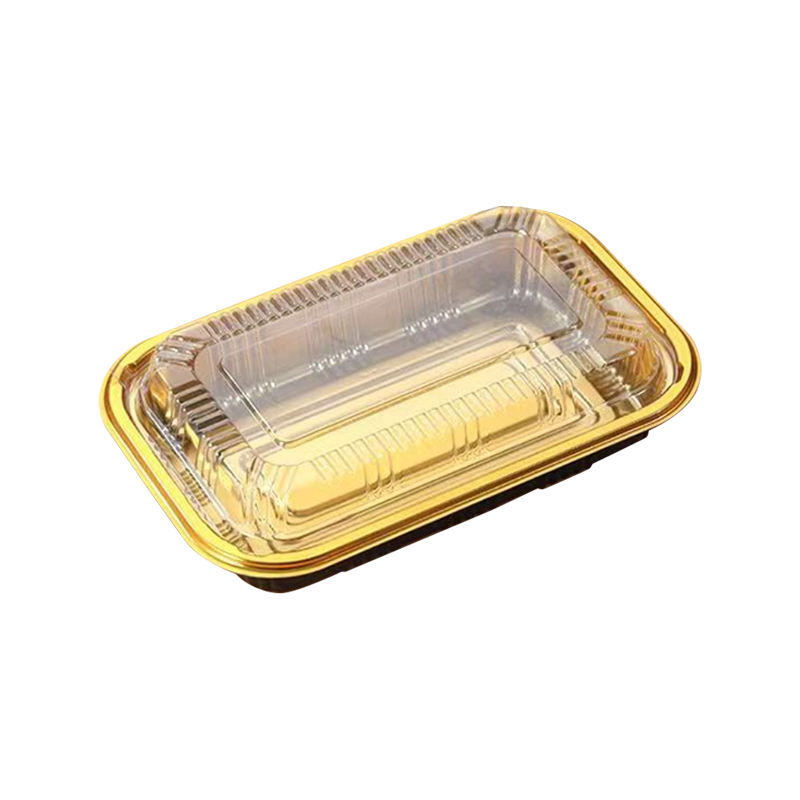
Heat, moisture and movement are the enemies. A PP tray with a secure lid, anti-overflow rim and microwave-safe base handles the full cycle from packing to customer reheating.
 多功能分隔包装托盘多隔间设计可分开存放蔬果、熟食等,防止串味和交叉污染,透气孔有助减少水分积聚,适合外带和存储需求。View Product →
Salad and fruit: stay crisp and readable
Salads sweat in the box, and moisture is what turns leaves soft. An anti-fog cover keeps the product visually fresh, while a tray with good rigidity prevents bruising of fruit.
 防雾盖沙拉餐盒配备防雾盖,避免冷凝水打湿生菜,分隔层便于搭配水果和配菜,刚性托盘减少挤压损伤,适合外卖和展示。View Product →
Working with a factory that understands thermoforming
Standard trays cover many needs, but most food brands eventually want something custom — a specific compartment count, a brand-matched colour, a logo printed on the base, or a tray dimension that fits a new retail display. This is where the factory's tooling capability matters more than the catalogue.
A supplier with in-house mould design can turn a rough sketch into a production tool and test the tray against your real product before mass production. Donghang's model combines its own tool shop, production lines and export sales team, which shortens the feedback loop between your kitchen trials and the final container.
For custom work, ask for three things: a sample made from the actual production material, a stacking test with filled product, and a written specification of the food-contact grade used.
Five checks before a large order
Once the design is agreed, verification prevents expensive surprises. Run through this checklist with the supplier:
- Confirm the polymer grade and any recycled content in writing.
- Request food-contact compliance documents for the market you sell into.
- Test the tray with the actual food at actual packing temperature.
- Check stacking strength, lid fit and leak resistance with a filled sample.
- Agree on lead time and minimum order quantity for repeat supplies.
The environmental question is also a cost question
Single-use trays are being scrutinised for waste, and the conversation is now pragmatic rather than ideological. The best packaging minimises material while protecting the food. Right-sizing a tray to the portion — rather than using one size for everything — cuts both material cost and waste volume.
For brands that want further progress, options include trays with recycled content, recyclable mono-material structures, and degradable formulations for specific applications. What matters is verifying the claim against the actual waste stream in your market, because a tray that cannot be collected or recycled still ends up as residue.
The right plastic tray for ready to eat food is the one that matches the food's temperature, protects it through the supply chain, presents it clearly to the customer, and does all of this within a cost structure that makes sense at volume. Start with the material, then the design features, and then the supplier's tooling and quality control. If all three align, the tray stops being a packaging cost and becomes part of the product experience.



- The company requires rigorous, using a high starting point, trustworthy, quality, and actively develop and innovate, the pursuit of excellence route!
CONTACT US
- Tel: +86-15026677788
- E-mail: [email protected]
- Add: No.11 Huafeng Road, Anhua Community, Anhua Town, Zhuji City, Shaoxing, Zhejiang, China
GET A QUOTE
Copyright @ Donghang Polymer Material Technology Co., Ltd. All Rights Reserved.
 Custom PVC Blister Plastic Boxes Manufacturers
